What Decides the Cost of Tree Removal? A Factor-by-Factor Guide
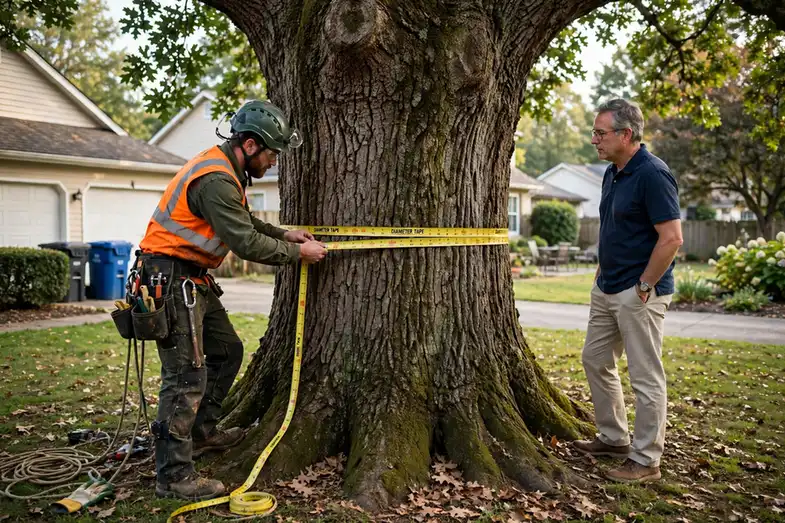
Ask three neighbours what tree removal cost them and you will hear three wildly different numbers — for trees that looked, from the driveway, about the same. The differences are not arbitrary. Professional removal quotes are built from a consistent set of factors, and once you know them you can read any quote, compare two quotes intelligently, and spot the one that forgot something important.
This guide deliberately contains no prices. Numbers you find elsewhere are national averages smeared across every tree, region and situation, and they tell you almost nothing about your tree. What follows instead are the factors your local provider is actually weighing — the same list ArborReach's service pages use — and how each one moves the scope of the job.
1. Size: height first, then trunk, then canopy
Height is the headline factor because it decides the working method. A tree a climber can dismantle in an hour of rope work and a tree that needs a crane are in different universes of scope. Trunk diameter adds cutting and handling volume; canopy spread multiplies the number of pieces that must be rigged, lowered and processed.
This is why 'how much to remove a tree?' has no honest generic answer: the tree in the question is doing all the work. When you request quotes, give the species if you know it and the approximate height — providers can pre-plan far better, and the quotes you get back will be tighter and more comparable.
2. Position and targets: what stands underneath
A tree in an open field can be felled in one piece and processed at leisure. The same tree over a roof, a pool, a glasshouse and a fence must come down in dozens of rope-lowered sections, each one swung clear of something breakable. Targets underneath the tree are the second great driver of scope, and the least visible from the ground.
Proximity to power infrastructure is its own category: work near conductors is slower, sometimes requires the utility's involvement, and never tolerates improvisation. If your tree touches the lines, expect the quote conversation to start there.
3. Access: the path for people, machines and debris
Can a bucket truck or crane reach the tree? Can a chipper get within hose distance, or is every branch being dragged through a garden gate by hand? Access decides crew size, equipment and hours more quietly than any other factor — and it is the one most often underestimated by owners comparing quotes.
Gate width, slopes, soft ground, septic fields and distance from the street all count. Mention access constraints when you first call; the provider who knows about the narrow side yard sends the right crew the first time.
4. Condition: dead and decayed trees cost more care
It seems backwards until you think like a climber: a sound tree can be climbed and rigged from itself; a dead or rotten tree may not safely hold a climber, ropes or its own falling pieces. Such trees often need a lift or crane, smaller pieces, and slower work — more scope, applied to the least predictable material.
Storm-damaged trees are the extreme case: tension, hang-ups and shifted root plates make every cut a calculation. If your tree is already down and resting on things, the quote reflects the unloading problem, not the tree's original size.
5. Species and wood character
Dense hardwoods are heavy in every piece and slow to cut; brittle species shatter unpredictably; palms are fibrous, heavy and handled by their own rules; pines are comparatively obliging. Species also decides disposal: diseased wood from regulated diseases may have to leave the neighbourhood, while clean hardwood might become your firewood at no extra handling cost.
Multi-stemmed and codominant trees — common in fast-growing ornamental species — effectively multiply the job: several trunks, several rigging plans, one root plate.
6. The finish you choose: stumps, wood and clean-up
Quotes differ because finishes differ. Stump grinding or full stump removal is its own line of scope. Debris can leave on the truck, stay as mulch from the chipper, or stay as firewood lengths. Each option is legitimate; trouble starts when you compare a quote that includes everything with one that quietly includes none of it.
The fix is simple: ask every provider to quote the same finish — same stump treatment, same debris handling, same clean-up standard — and comparisons become honest. A written scope, even a short one, protects both sides.
7. Permits, season and demand
In ordinance cities, permit fees and replacement-planting conditions are part of the project, and someone has to do the paperwork. Timing matters too: after a regional storm, every crew within fifty miles is triaging emergencies and standard work queues behind it — the same removal scheduled in a quiet month is a calmer, often better-planned job.
None of this means waiting with a dangerous tree: hazard work should never be deferred for price weather. It means the routine removal you have been meaning to book is best booked before the season makes it urgent.
Guide FAQs
Why did two quotes for the same tree differ so much?
Usually because they are not quoting the same job. Check the finish (stump? debris? clean-up?), the method (crane included or 'we'll see'?), and whether permits are in or out. A low quote that assumes easy felling on a tree that needs rigging is not cheaper — it is unfinished. Ask each provider to state scope in writing and the gap usually explains itself.
Can I reduce the cost by keeping the wood?
Keeping firewood lengths or chipper mulch removes haul-away from the scope, and many owners do exactly this. What does not reduce scope is asking the crew to 'just drop it' — an uncontrolled fall is not a discount, it is a risk transfer no reputable provider will sell you. The legitimate savings are in the finish, not in the safety.
Does tree removal cost more in an emergency?
Emergency work carries real premiums: night and storm conditions, immediate response, triage priority. That is the honest economics of a crew leaving other work to unload your roof at midnight. The way to avoid emergency pricing for predictable problems is the unglamorous one: act on the assessment that flagged the tree, in a calm month.
More guides
Talk to a local tree professional today
One call connects you with an independent tree service in your area — for an assessment, a quote, or urgent help with a dangerous tree.
Call NowArborReach USA is a referral service. We connect property owners with independent local tree care professionals; we do not perform tree work ourselves.