About this service
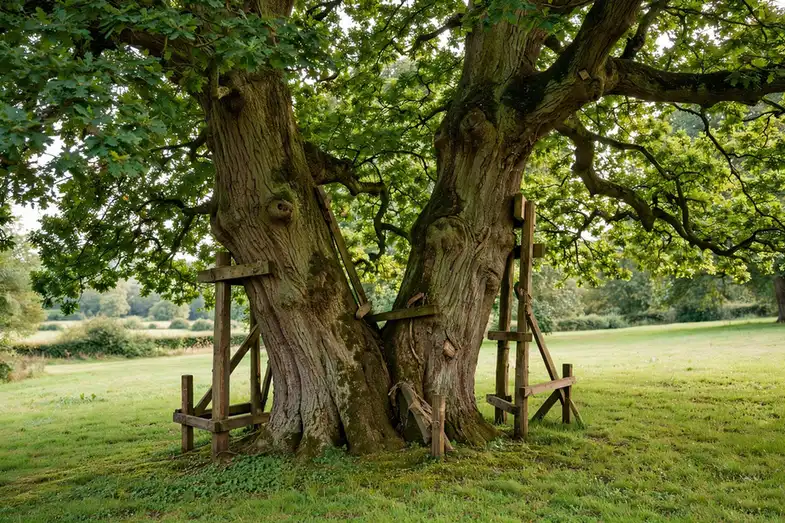
Some trees are worth saving and almost strong enough to save themselves. A heritage oak with two co-dominant stems, a beloved maple whose main union is starting to open — cabling and bracing install a support system inside the tree that shares the load between stems, limits how far a weak union can flex, and turns a probable split into a managed, monitored structure.
ArborReach USA connects you with local arborists who assess, install and inspect support systems. This page explains when cabling works, how systems are designed and installed, what they cannot do, and the inspection rhythm that makes them a solution rather than a decoration.
Trees that are candidates for support systems
- Co-dominant stems with a tight fork. Two stems of similar size rising from one point, especially with bark included in the union, are the classic cabling candidate.
- A crack forming at a main union. A crack that opens in wind or under load is the tree asking for help before the split completes.
- A heavy, over-extended limb. Long horizontal limbs over roofs and drives can be supported from above instead of removed, keeping the tree's shape.
- A valued tree with a known defect. Heritage and specimen trees with manageable structural flaws are supported to extend safe life rather than removed at first concern.
- Storm-survived unions. A union that twisted in a storm but held is a candidate for support plus reduction pruning before the next test.
- Trees over high-value targets. Where people, roofs or vehicles live under a structurally imperfect tree, support plus monitoring manages a risk removal would erase entirely.
How the work runs
Structural assessment
The union, wood quality and load paths are assessed first — support systems supplement sound wood; they cannot substitute for it.
Design
The system is specified: cable type and placement in the upper crown, brace rods through weak unions where needed, and companion pruning to reduce load.
Reduction pruning
End weight on the supported stems is reduced — cables are installed alongside pruning, never instead of it.
Installation
From the canopy, the crew installs anchors and cables with the specified slack, and brace rods where the design calls for them, using hardware rated for tree support.
Documentation
The system, its date and its design are recorded — future crews (and future owners) need to know it is there.
Inspection cycle
Support systems are inspected on a regular cycle — typically every few years and after major storms — and adjusted or renewed as the tree grows.
In detail
How a cable actually helps
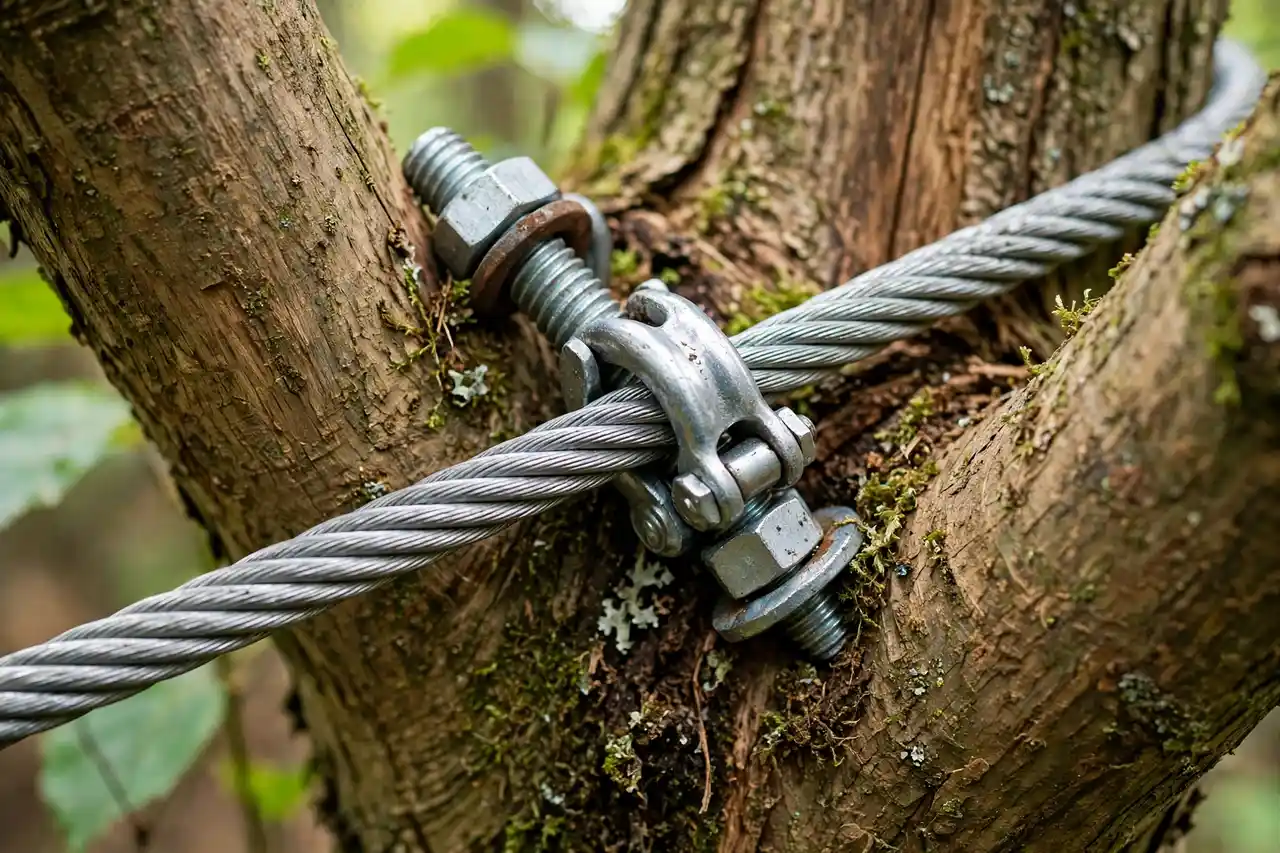
A cable between two stems does not hold the tree together like a strap; it limits the distance the stems can move apart, so the peak strain at the union in a gust stays below the splitting point. Working high in the crown — commonly two-thirds of the way up — gives the system leverage while the stems still flex naturally below it.
Brace rods work differently: threaded rods installed through a weak or cracked union bolt the wood together at the point of failure itself. Most serious systems combine both — rods at the union, cables above — and all of it works in partnership with the weight reduction from pruning.
Static vs. dynamic systems
Traditional steel cable systems are static: strong, long-lived, and unyielding. Modern dynamic systems use synthetic rope with a degree of stretch, letting the tree move more naturally — movement that stimulates the tree to lay down strengthening wood — while still catching the extreme excursions that split unions.
The choice depends on the tree, the defect and the target below; dynamic systems are often favoured for younger, vigorous trees and steel for maximum restraint on high-risk unions. Your arborist should be able to explain which they are installing and why, in terms of your tree — not just their stock.
The honest limits
Support systems manage risk; they do not erase it, and they cannot rescue a tree whose union is already mostly decayed or whose roots are failing. They also carry an obligation: a cabled tree is a tree on a monitoring plan, because hardware ages, trees grow around anchors, and loads change as crowns develop.
Presented correctly, cabling is one of arboriculture's best tools — it has kept generations of landmark trees standing safely. Presented as a fit-and-forget cure, it is a liability. The assessment conversation should include the words 'inspect every few years' — if it does not, ask why not.
Cabling and the landmark tree problem
Every town has them: the courthouse oak, the founder's maple, the tree in the park that appears in a century of photographs. Such trees outgrow their structure before they outgrow their welcome, and removing them is a civic loss no replacement repairs within a generation. Support systems exist precisely for this gap between a tree's structural age and its cultural value.
The same logic applies at garden scale. The tree your grandfather planted, the one that shades the whole house, the one in every family photograph — its value is not fungible, and a support system that buys it a decade of safe life, honestly monitored, is money spent on something real.
What installation day looks like
Cabling is canopy work: a climber (or a lift, where access allows) works in the upper crown, drilling anchor points in sound wood, running the cable or dynamic rope between stems, and tensioning it to the design's specification — supported, not winched tight. Brace rods at the union are drilled through and bolted, a slower, more surgical piece of work done at close quarters.
The companion pruning happens in the same visit: the supported stems lose end weight so the system is never asked to hold the full original load. Afterwards the tree looks almost unchanged — which is the point. Everything that changed is up in the crown, working quietly.
Cables, lightning and the tall-tree package
While a crew is aloft installing support in a tall, valued tree, a second protection is worth considering: lightning protection systems — copper conductors run from the crown's highest points down to ground rods — are standard practice for champion and heritage trees, and Bartlett-style scientific tree care has recommended them for a century. Tall trees near houses are the region's lightning rods whether we equip them or not.
The systems are unobtrusive, long-lived and inspected on the same cycle as the cables. Not every tree warrants one; the candidate is tall, prominent, valued and near a structure — if your tree is being cabled, it likely already meets most of that description, and the conversation costs nothing.
When support is declined: the alternatives
Not every defective union should be cabled, and a good assessment names the alternatives honestly. Aggressive reduction pruning can sometimes cut the load enough to stand alone; a younger replacement planted now begins its twenty-year apprenticeship while the old tree serves its last safe years; and sometimes removal is simply correct — the defect too deep, the target too occupied, the wood too far gone to hold hardware.
What you are buying in the consultation is that sorting, defended with reasons you can test. Support systems are wonderful tools; the professionalism is in knowing — and saying — when this tree is not one of their cases.
Living with a supported tree
A cabled tree is a tree with a maintenance obligation, and buyers should take it on knowingly. The hardware needs professional inspection on a cycle — typically every two to three years, and after any major storm — because cables slacken as the tree grows, anchors corrode over decades, and a support system nobody inspects eventually becomes decoration. Put the inspection dates in the same diary as the pruning cycle and the obligation costs almost nothing to honour.
Tell future crews the tree is supported before they climb it — a cable changes how a crown moves under load, and pruners plan cuts around it. When the house sells, disclose the system with its paperwork: a documented, inspected support on a heritage tree reads as diligence to a buyer's arborist, while an undocumented cable discovered mid-inspection reads as a mystery. The supported tree, properly introduced, is an asset with a service history.
When support is the wrong answer
For honesty, the cases where cabling should not be sold: a union with advanced internal decay, where the wood holding the anchors is itself failing; a tree already in decline from root disease, where support treats the symptom of a dying structure; and a lean driven by a lifting root plate, which is a soil-and-roots problem no cable addresses. In each case the safe money goes to removal and replacement, and a firm that tells you so against its own interest in the cabling job is a firm to keep.
There is also a budget truth: support plus the pruning it requires plus a decade of inspections can approach removal-and-replant costs for a small tree. The case for support is strongest exactly where replacement is impossible — the mature heritage tree whose size, shade and presence took forty years to build. Where the tree is young or ordinary, the arithmetic often favours starting again with a well-chosen, well-planted tree in the right place.
What drives the scope of a support system
- Number of systems and stems. A single cable vs. a multi-cable network with brace rods are different installations.
- Crown height and access. Hardware is installed aloft; big trees and difficult access add climbing time.
- Companion pruning. Most systems include reduction pruning of the supported stems — a significant part of the visit.
- Hardware type. Steel static systems, dynamic synthetic systems and brace rod sets carry different material scope.
- Tree condition. Decay investigation at the union — sometimes including resistance drilling or imaging — precedes serious installations.
- Inspection commitment. The initial visit is one part; the inspection cycle is priced and scheduled as its own rhythm.
Should you do it yourself?
There is no DIY version of this service. Support hardware must be installed at height, anchored in the right wood, tensioned to a design, and matched to the defect — a hardware-store cable lagged into the wrong spot concentrates load, wounds the tree, and gives false confidence, which is worse than honest concern. The homeowner's role is the valuable one anyway: noticing the crack, making the call early, and keeping the inspection appointments.
Frequently asked questions
Will cabling guarantee my tree will not split?
No — and any provider who guarantees it is overselling. A properly designed system, installed with companion pruning and inspected on schedule, substantially reduces the chance of a split and the damage if one occurs. It converts an unmanaged risk into a managed one. Trees over critical targets still deserve honest periodic review of whether support remains the right strategy.
How long do cables last?
Steel systems commonly serve for many years; synthetic dynamic systems have shorter rated lives and are replaced on schedule. Both are affected by tree growth — anchors can be grown over and systems can become too tight or too slack — which is why rated life is only part of the story and inspection is the rest. Your installation should come with a documented inspection interval.
Does installing a cable hurt the tree?
Anchors pass through the wood, which is a wound the tree must seal — one reason installation is kept to the hardware the design actually needs. Installed correctly in sound wood, quality systems are well tolerated, and the alternative for these trees is usually removal. Brace rods through a union are a bigger intervention, reserved for unions that need them.
Can a cracked union be cabled?
Often, yes — a crack that has not progressed to advanced decay is precisely the case brace rods plus cables are designed for: rods bolt the cracked union, cables limit its movement, and reduction pruning cuts the load. If the crack is accompanied by extensive decay, the wood may not hold hardware, and removal becomes the honest recommendation.
What does the inspection involve?
A climber or lift visit to check hardware condition, cable tension, anchor points and the union itself, plus a fresh look at the crown's load and any new defects. Trees change; the system is adjusted to the tree it is in now, not the tree it was installed in. After major storms, an extra check is wise for trees over structures.
Is cabling cheaper than removal?
The installation visit alone is generally less work than removing a large tree — but the honest comparison includes years of inspections and the eventual end of the tree's safe life. The reason to cable is not cheapness; it is that the tree is worth keeping — for shade, history, screening or sheer presence — and support makes keeping it responsible.
Can a cabled tree still fall?
Yes — support reduces specific risks (a union splitting, a limb tearing out); it does not make a tree immortal or protect it from root failure, trunk decay or a storm beyond design assumptions. That is why cabled trees stay on an inspection cycle and why the assessment is redone honestly every few years: the goal is managed risk with open eyes, not a certificate of immortality.
Do cables need to be replaced as the tree grows?
Systems are adjusted and eventually renewed: anchors are swallowed by growth, dynamic ropes reach their rated life, and the crown's weight distribution changes as the tree develops. Your installation record should carry the inspection interval, and a provider who installs and vanishes has done half the job — ask who inspects it, and when, before you agree to installation.
My tree has two trunks. Does it automatically need a cable?
No. Plenty of co-dominant trees stand for a century uncabled — the deciding features are the union's shape and contents: a wide U-shaped fork with no included bark is a far happier structure than a tight V with bark wedged inside and a crack starting. Species, load, targets below and the tree's overall vigour all enter the judgement. This is precisely what the assessment is for: many twin-trunked trees are told 'monitor', some are told 'reduce', and only the genuinely risky ones are told 'cable'.
Does cabling affect my tree's value or insurability?
Generally positively, when documented: a valued tree under a professional support and inspection regime is a managed asset, and insurers prefer managed risks to unmanaged ones. Keep the installation record and inspection reports with your property documents — they are the evidence that turns a known defect from a liability story into a management story.
Cabling & Bracing in top metro areas
Related services
Need cabling & bracing? Talk to a local professional
One call connects you with an independent tree service in your area — for an assessment, a quote, or urgent help with a dangerous tree.
Call NowArborReach USA is a referral service. We connect property owners with independent local tree care professionals; we do not perform tree work ourselves.