About this service
The storm passes in a night; the mess it leaves in your trees takes longer. Broken hangers in the canopy, a yard under three inches of snapped limbs, one tree down across the fence and two more quietly wounded — storm cleanup is its own discipline, part removal, part triage, part careful pruning of trees that can and should be saved.
ArborReach USA connects homeowners and property managers with local tree services for post-storm work across the country. This page explains how cleanup is prioritised, what to do before the crew arrives, how damaged trees are assessed for saving, and how to come out of storm season with a safer canopy than you went in with.
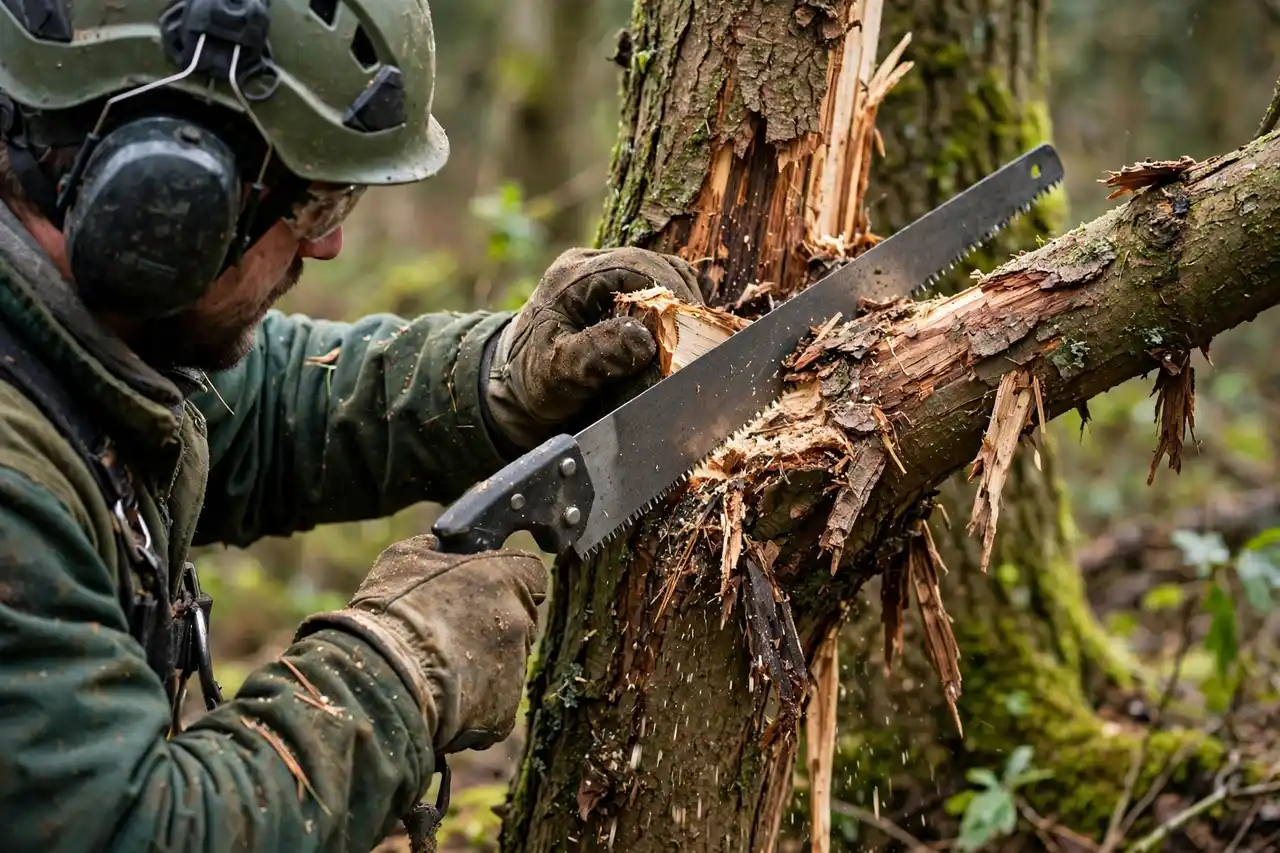
Storm damage that needs professional attention
- Hangers — broken limbs still in the canopy. A partially attached limb is a falling object on a timer. Hangers over roofs, paths and parking are the first priority of any cleanup.
- Split trunks and cracked unions. Storm-twisted trees often show a crack running from a fork down the trunk — structural failure that pruning cannot fix.
- Uprooted and leaning trees. Any tree whose root plate has lifted, even slightly, has lost its anchor and belongs at the front of the queue.
- Debris fields and blocked access. Downed limbs across drives, roofs and fences — plus the sawn wood, brush and stump left behind — are the bulk work of cleanup.
- Damage you cannot see from the ground. Torn branch collars high in the crown, root damage on the windward side, and bark ripped from the trunk show up weeks later as dieback if they are missed.
- A neighbour's tree in your yard (or yours in theirs). Storms do not respect fences. Clean-up responsibilities and shared trees need a calm, documented conversation alongside the saws.
How the work runs
Triage and safety sweep
The crew walks the whole property first: hazards (hangers, splits, lifted roots) ranked and handled before cosmetic work begins.
Emergency items first
Anything on a structure, over access, or in danger of falling is made safe — this may be the same work described on our emergency page.
Salvage assessment
Damaged but standing trees are judged one by one: what can be pruned back to sound structure, and what is safer removed.
Corrective pruning
Torn limbs are cut back to proper collars — jagged storm breaks left alone become decay columns — and crowns are rebalanced after losses.
Debris processing
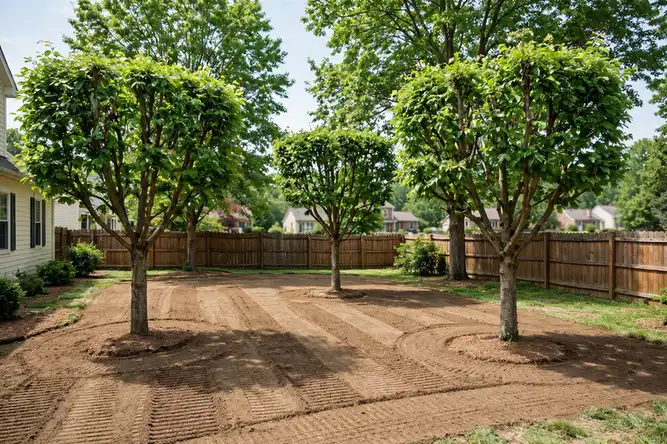
Downed wood is cut, chipped or stacked as agreed; hangers are rigged down; the yard is cleared in sections so progress is visible.
Final sweep and advice
Raking and blowing finish the site, and the crew flags anything to watch — a crack to monitor, a tree that should come out before the next season.
In detail
Saving the wounded: restoration pruning
A tree that loses a third of its crown in a storm looks finished, and often is not. Restoration pruning — cutting torn ends back to sound laterals, re-establishing a leader over successive seasons, and reducing (not removing) stressed limbs — brings many storm-damaged trees back to a safe, natural shape over two to three years.
The candidates are trees with sound trunks and root systems whose damage is in the branches. The non-candidates are just as important to identify honestly: split trunks, lifted roots and decayed stems do not heal, and money spent 'saving' them is better spent on removal and a well-chosen replacement.
Whose tree, whose bill: the neighbour question
The general pattern in most states: a tree that falls from a neighbour's property is usually handled by the owner of the property it fell on (and their insurer), unless the tree was visibly dead or dangerous and the owner had been put on notice. Rules vary, and this page is not legal advice — but it is why documenting a dangerous tree in writing, before it falls, matters.
For the cleanup itself, crews routinely work both sides of a fence in one visit when neighbours agree. Storms are easier to recover from as a street than as a household, and shared trees straddling a boundary are best handled with both owners in the conversation from the start.
Before the next storm: the real cleanup
The most valuable hour of storm work happens on a calm day months earlier. Structural pruning of mature trees, removal of deadwood, cabling weak unions, and taking out the trees that assessments keep flagging — this is what turns a hurricane or ice storm from a property disaster into a debris event.
After any major storm, book the assessment while the damage is fresh in mind; by the time the next season approaches, every good crew's calendar is full of exactly the preventive work that should have been unhurried.
Reading a storm-damaged tree: the assessor's walk
Professionals assess storm trees in a set order, and it is worth knowing: roots first (any lift, crack or heave at the base), then trunk (longitudinal cracks, torn bark, twist), then the unions, then the crown. The order reflects the verdicts — a tree can survive enormous crown loss, but root failure and trunk splits are the findings that end the conversation.
Homeowners tend to judge by the canopy, because that is what they see. The canopy is also the part most capable of recovery. When your assessor spends their time at the base of the tree with a mallet and a probe, they are looking at the parts that decide — and they should be able to show you what they find.
Debris: the economics of the aftermath
After a major storm, the region's green-waste system becomes the bottleneck: chippers queue at debris sites, and haul-away scope grows expensive in simple supply and demand. Owners with space often choose the pragmatic split — chip and keep mulch on site, haul only the big wood — which clears the property at the speed of the chipper rather than the speed of the motorway.
Firewood is the other honest option: storm hardwood, cut and stacked, seasons into a winter's fuel. If you do not burn wood, neighbours who do are rarely hard to find in storm week. What does not work is the burn pile in a jurisdiction that forbids it — check before anyone strikes a match.
Cleanup sequencing on a multi-tree property
When a storm has worked over a wooded property, cleanup is a campaign, not a visit: hazards first, access second, salvageable trees third, debris last — and the debris is staged, because a property can generate more wood in a weekend than a crew can chip in a day. Expect the crew to open with a triage walk and a priority list you both agree, then work it in order.
Ask for the list in writing with the standing trees' verdicts marked. Six months later, when a wounded tree's decline becomes visible, that document is the difference between a planned removal and a second surprise — and insurers, again, read documents with more sympathy than they read memories.
Preventive work the storm just argued for
Every storm is an audit with the results written in other people's yards. The trees that failed share a short list of confessions: dead tops, included bark, root plates in saturated soil, canopies never thinned in twenty years. Your standing trees can be checked against that list on a calm day, at standard rates, by appointment — which is the entire economics of preventive arboriculture.
Book that check while the evidence is fresh around you. The regional calendar on your city page shows the working seasons; the storm has already shown you the stakes. The owners who come out of storm season with safer properties are simply the ones who converted the lesson into a booking.
Sorting the keepers from the casualties
Not every storm-damaged tree is a removal. The morning-after assessment sorts trees into three honest groups: the sound (debris only, no structural injury), the wounded-but-viable (torn limbs, lost leaders, moderate crown loss — recoverable with corrective pruning over two or three seasons), and the lost (split trunks, lifted plates, failures into targets). Experienced crews make these calls conservatively but not wastefully: a tree that lost a third of its crown in a clean break pattern often recovers fully; a tree that 'only leaned a little' with a lifted root plate often does not survive the year.
Keep the assessment written down, tree by tree, even if it is just the crew leader's notes. After a regional storm, that list becomes your schedule — hazard work now, corrective pruning this season, monitoring at the next visit — and it is also the document an insurer or an HOA dispute will ask for. Photographing each damaged tree before work starts, from two angles, takes five minutes and is worth more than any receipt.
Debris: what leaves, what stays, what it becomes
A cleanup generates three streams. Sound logs are firewood or mill stock — some homeowners keep them, some crews take them, and big straight hardwood sections occasionally go to local sawyers rather than the chipper. Brush and small wood become chips, which you can keep as mulch (storm chips are excellent for beds and paths) or have hauled. Rubbish — roofing, fencing, the storm's general litter tangled in the pile — is separated and disposed of separately.
Decide these streams with the estimator, not the crew at the curb, because they change the quote's shape: hauling everything away is more truck time; keeping chips and firewood is less. None of the options is the 'wrong' one, but a yard left with an unexpected mountain of chips is a classic post-storm complaint, and it is always the result of a conversation nobody had.
What drives the scope of storm cleanup
- Number and size of damaged trees. One wounded oak is a visit; a wooded lot after a derecho is a project. Scope starts with the count.
- Hazard level of the damage. Hangers, splits and lifted root plates need rigging and care; flat debris on open ground moves fast.
- Volume of material. Chipping and hauling capacity often sets the pace — a big storm makes a lot of green waste very quickly.
- Access after the storm. Blocked drives, downed fences and saturated ground that will not take equipment all slow the work.
- Salvage vs. removal mix. Restoration pruning takes more skill-time per tree than removal; the mix shapes the crew and the schedule.
- Disposal route. On-site chipping into beds vs. full haul-away to a storm debris site are different scopes.
Should you do it yourself?
Post-storm yards are deceptively dangerous places: limbs under tension, hangers that drop when the ground vibrates, and trunks that roll when cut free. Do the safe parts — photograph damage, move loose small debris from open ground, keep children and pets inside until the canopy has been checked — and leave everything attached, suspended or larger than you can comfortably carry to the crew. Especially: never cut a limb that is holding something else up.
Frequently asked questions
How soon after a storm should cleanup happen?
Hazards — hangers, splits, trees on structures — as soon as crews can safely reach you. The rest can be scheduled over the following days, but do not wait months: torn limbs left uncut invite decay, and damaged trees assessed early have the best chance of being saved. After regional storms, booking early also matters because every property in the area is calling at once.
Can a storm-damaged tree be saved?
Frequently, yes, if the trunk and roots are sound and the damage is in the branches. Restoration pruning over a couple of seasons rebuilds structure. Trees with split trunks, cracked root plates or more than half the crown gone are usually removal candidates. The assessment is the valuable part — a good arborist will argue for saving a saveable tree, because it is worth more alive.
My neighbour's tree fell in my yard. Who organises the cleanup?
In most places, the property owner where the tree landed arranges and pays for cleanup on their own land (often through their insurer), unless negligence — a known dead or dangerous tree — was documented beforehand. Rules vary by state, so check locally. Practically, neighbours often split a single crew visit for a shared mess; crews are used to working it out on site.
What should I do before the crew arrives?
Photograph the damage for insurance, from safe positions only. Keep people and pets away from damaged trees. Move vehicles that are clear to move. If a roof is breached, protect the interior. Resist tidying the big pieces — the crew reads the wreckage to plan their cuts, and pre-cut wood under tension is a hazard to everyone.
Does cleanup include hauling everything away?
It can, and the choice is yours: full haul-away, chipping on site with mulch left for your beds, or firewood left stacked. Decide before the crew starts, because debris handling is a real portion of the scope. Storm wood from diseased trees may need to leave the property regardless — the crew will advise where that applies.
Should I have my other trees checked after a storm?
Yes — this is the most-skipped and most valuable step. Storms wound trees invisibly: root cracks, twisted stems and torn collars that fail months later on a calm day. A walk-through assessment of every large tree near structures, done while storm evidence is fresh, catches the second wave before it falls.
Should I clear the small stuff myself to save money?
Grounded, loose debris in open areas — yes, it is safe and it does reduce the crew's bulk work. Set your boundary firmly: nothing attached, nothing suspended, nothing you have to climb or cut under tension, and always check above before working below. Tell the crew what you have already moved; a tidy pile at the kerb is genuinely helpful.
The storm was weeks ago. Is it too late for restoration pruning?
Not usually. Torn limbs should ideally be cut back within the first weeks, but trees are forgiven by seasons, not days — a restoration programme begun a month after the storm still does its work. What does decay with time is the evidence: cracks close over, dieback patterns blur. Earlier assessment is better; late assessment is far better than none.
Storm Damage Cleanup in top metro areas
Related services
Need storm damage cleanup? Talk to a local professional
One call connects you with an independent tree service in your area — for an assessment, a quote, or urgent help with a dangerous tree.
Call NowArborReach USA is a referral service. We connect property owners with independent local tree care professionals; we do not perform tree work ourselves.