About this service
Pruning is the highest-value work in tree care: done on a cycle, it is how a tree keeps a strong structure, clears roofs and lines, sheds storm winds instead of catching them, and stays an asset for decades. Done badly — topped, lion-tailed, or cut with dull tools at the wrong season — it creates exactly the weak regrowth and decay that bring trees down early.
ArborReach USA connects you with independent local tree services for structural pruning, canopy work and routine trimming across the country. This page explains the main types of pruning, how a professional visit runs, when in the year your trees should be cut, and what separates sound pruning from the practices that harm trees.
Signs your trees are due for pruning
- Deadwood in the canopy. Dead branches are the first thing a storm throws. A crown carrying visible deadwood over roofs, drives or play areas needs cleaning regardless of season.
- Branches touching the house or lines. Contact with roofing wears shingles and gives pests a bridge; branches in service drops are a utility problem waiting for wind.
- Crossing and rubbing limbs. Limbs that cross and rub wound each other, opening the door to decay. Removing the weaker one early is a small cut; later it is a big one.
- A dense, sail-like canopy. Over-thick crowns catch wind. Judicious thinning restores airflow and reduces the leverage a storm can apply to the trunk.
- Low limbs over paths and drives. Crown raising restores clearance for people, vehicles and sightlines — a routine need as trees mature over streets and sidewalks.
- Weak crotches and co-dominant stems. Two stems of similar size with bark wedged between them are a split waiting for load. Early structural pruning — or cabling — addresses it.
How the work runs
Crown assessment
The arborist reads the tree first: structure, defects, previous cuts, and what the tree needs over the next several years — not just today.
A pruning specification
The work is agreed in plain terms: crown cleaning, thinning, raising, reduction, or a combination, with a target of removing no more live wood than the tree can spare.
Access and setup
Climbers or a lift reach the canopy; ground crew establish drop zones and keep them clear while cutting is overhead.
Cuts at the branch collar
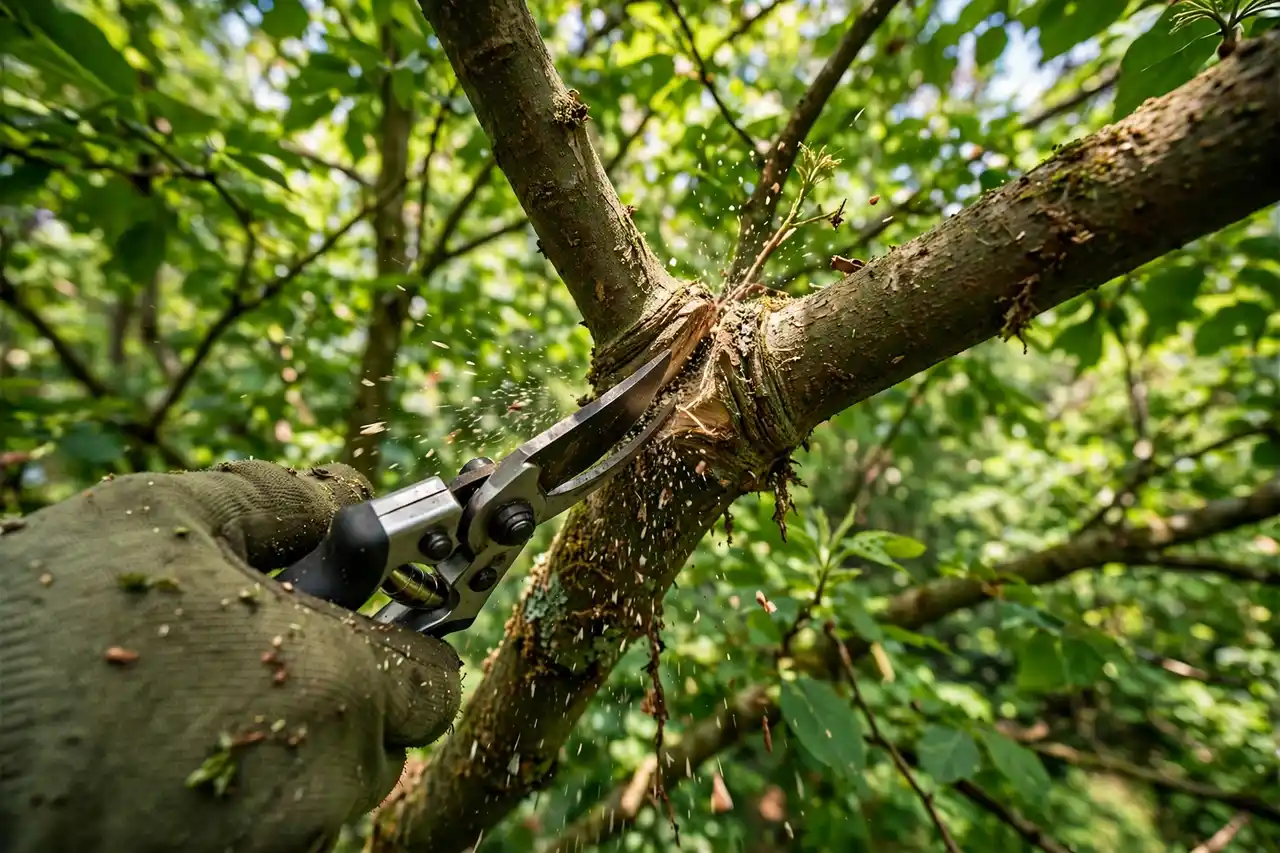
Every cut is made just outside the branch collar so the tree can seal the wound with its own tissue — no flush cuts, no stubs, no paint unless a local disease rule requires it.
Balanced shaping
The crew works around the whole crown, stepping back to check balance and light, rather than stripping one side.
Chip and clean-up
Brush is chipped, larger wood is handled as agreed, and the site is raked clear — the only evidence left should be a better-shaped tree.
In detail
The four cuts that matter: clean, thin, raise, reduce
Crown cleaning removes dead, dying, diseased and weakly attached branches — the baseline every mature tree needs. Crown thinning selectively removes live branches to improve light and airflow and reduce wind load, taking interior congestion rather than stripping the branch ends.
Crown raising lifts the bottom of the canopy for clearance over roofs, streets and people. Crown reduction shortens specific limbs back to a lateral branch large enough to take over — the correct answer when a tree has outgrown its space, and the polar opposite of topping, which simply lops every end and guarantees a flush of weak, fast regrowth.
Timing: the pruning calendar
For most shade trees, the dormant season is the safest and most effective window: structure is visible, disease pressure is low, and the tree responds with a full spring of growth to seal cuts. There are firm regional exceptions — oaks in oak-wilt country are pruned in the coldest months only, palms lose only dead fronds, and storm-damaged trees are pruned when they need it, not when the calendar says.
ArborReach's city pages carry the pruning window for your region, because the right month in Minnesota is the wrong month in Florida. When a provider proposes cutting a species at a risky time of year, asking why is always a fair question.
Topping and lion-tailing: the two practices to refuse
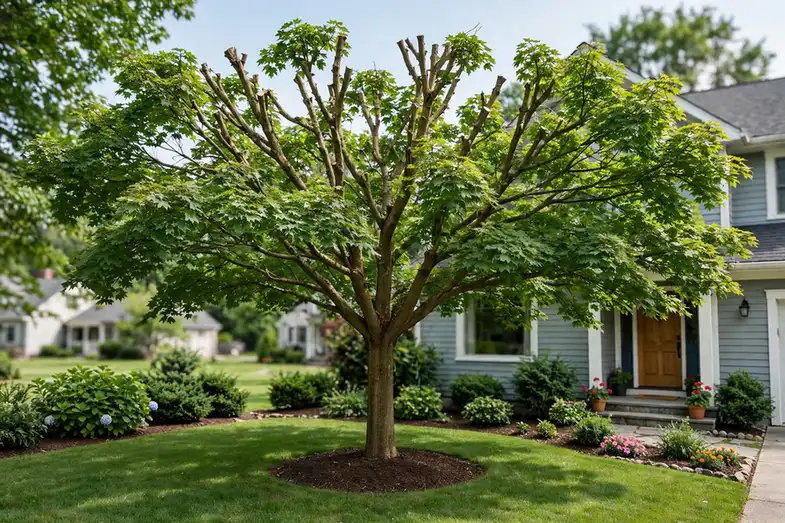
Topping — cutting a tree back to stubs to make it smaller — is condemned by every arboricultural standard, and for good reason: the regrowth attaches weakly, decay enters through the large wounds, and the tree becomes more dangerous than it was, faster. Any provider who offers to top your tree is telling you how they work.
Lion-tailing strips interior branches and leaves tufts at the ends, shifting weight outward where leverage is worst. A properly pruned tree looks like itself, only tidier — a tree that looks radically smaller or strangely bare after 'trimming' has usually been harmed, not helped.
Pruning young trees: the cheapest work in arboriculture
A sapling's structure is set in its first decade, and the corrections are tiny: choosing one leader, spacing scaffold branches, removing the crossing twig before it becomes a crossing limb. Ten minutes with a hand pruner on a young tree prevents the co-dominant stems, included bark and sail-heavy crowns that mature-tree budgets get spent on.
This is why planting services worth using include formative pruning in the establishment visits, and why owners of young street trees should ask for it by name. The mature canopy your street enjoys in thirty years is being decided, twig by twig, right now.
Pruning for clearance: roofs, lines and light
A large share of pruning work is really clearance work: branches off the roof before they wear the shingles, out of the service drop before the utility does it less gently, back from the chimney, the solar panels and the satellite's line of sight. Done by reduction cuts to suitable laterals, clearance holds for years; done by shearing the ends, it returns in a season as a thicker problem.
Utility line clearance deserves its own note: work within reach of energised conductors belongs to the utility's contractors, not your tree service. A good provider will tell you which part of your tree is theirs to cut and which part is the utility's — and time their visit accordingly.
Pruning by species: one rule does not fit all
Species biology rewrites the pruning brief. Oaks want restraint and winter timing in wilt country; maples bleed sap if cut in early spring (unsightly, rarely harmful, endlessly worried-about); birches and cherries resent heavy cuts and answer large wounds slowly; palms are not pruned at all in the shade-tree sense — only dead fronds and fruit are removed; pines are cut with an eye on candle growth and beetle season.
This is the knowledge the assessment visit is really selling. A provider who talks about your tree as a species — its habits, its diseases, its timing — is practising arboriculture. One who talks only about height and hours is selling cutting, and the difference shows up in the tree over the following five years.
The pruning cycle: little and often beats rare and drastic
Trees pruned lightly on a two-to-four-year rhythm almost never need heroic work: the cuts stay small, the wounds seal fast, the structure is guided rather than corrected, and the bill is a known quantity in the household budget. Trees pruned once a decade present the opposite arithmetic — large cuts, large wounds, large scope — and a canopy that lurches between overgrown and butchered.
If your trees have no cycle, the first visit sets one: the assessor will sort the property into 'this year', 'next cycle' and 'watch' — and a provider willing to defer two-thirds of your trees to later cycles is demonstrating the honesty the whole arrangement runs on.
Pruning young trees: the cheapest work you will ever buy
The most cost-effective pruning in a tree's entire life happens in its first decade. Young trees need structural pruning — selecting one central leader, spacing the scaffold branches, removing the narrow forks that will split at year twenty — and it takes minutes per tree because every cut is small. The same corrections at maturity take a crew, a lift and a day. If you plant or inherit young trees, a light structural pass every two or three years builds the architecture the tree will carry for a century.
Young-tree work is also where restraint matters most: never remove more than a small share of a young crown in one visit, keep the temporary branches low on the trunk until the trunk has built taper, and resist shortening a young tree to 'keep it small' — choose the right mature size at planting instead. The payoff for this patience is invisible for years and then obvious forever: the straight, well-spaced, storm-tough tree on the street that never seems to need emergency work is almost always one that was pruned young.
What a pruning crew should leave behind
Judge a pruning job when the crew leaves, not while it runs. The ground should be clear of brush and chips unless you asked to keep them; every cut should sit at a branch collar with no stubs and no flush wounds; and the tree should look like itself — the same species silhouette, just cleaner, lighter in the right places and clear of the roof and wires. If the tree looks dramatically smaller or oddly shaped, too much came off, whatever the paperwork says.
Ask the crew leader to walk the tree with you before they pack up: which wounds to watch, which union they are monitoring, and when they would come back. Good pruners answer in specifics because they made decisions in specifics. Keep their notes with the house paperwork — a pruning history is genuinely useful to the next crew, to an insurer after storm damage, and to a buyer when the house sells, because mature well-kept trees are a documented asset rather than a guess.
What drives the scope of a pruning job
- Tree size and canopy volume. Pruning time scales with crown size; a mature oak is a different job from a young ornamental.
- Amount and type of cutting. A deadwood clean-out is faster than a full structural prune with reduction work on multiple limbs.
- Access and targets below. Work over roofs, glass and gardens is slower, rope-heavy work; open lawn trees go faster.
- Species and condition. Brittle species, decayed unions and previous bad cuts all add care and time.
- Number of trees. Per-tree scope drops when a crew can work a whole property in one visit.
- Debris volume. Large prunings generate serious brush; chipping and haul-away are part of the scope.
Should you do it yourself?
Small ornamental pruning from the ground with hand tools is reasonable homeowner work. Everything above that — ladder work with a saw, cuts over structures, structural corrections on large trees — belongs to trained climbers with rigging. Ladders and chainsaws are a notorious pairing, and a falling limb weighs far more than it looks. The other DIY trap is knowledge, not equipment: cutting at the wrong place or season does slow damage you will not see for years.
Frequently asked questions
What is the difference between trimming and pruning?
In practice the words are used interchangeably by most companies. Arborists tend to use 'pruning' for deliberate cuts made for structure, health and clearance, and 'trimming' for shaping and routine maintenance. What matters is not the word but the work: ask what will be cut, how much live wood will come off, and what standard the crew prunes to.
How often should my trees be pruned?
Young trees benefit from light structural pruning every two to three years while their framework forms. Mature shade trees typically run on a three-to-five-year cycle for cleaning and clearance, adjusted for species, condition and what stands beneath them. Fast-growing and brittle species need the shorter end of those cycles.
When is the best time of year to prune?
Late autumn through late winter — the dormant season — suits most shade trees in most of the country. The exceptions matter: oaks where oak wilt is present should only be cut in deep winter, flowering ornamentals are timed around bloom, and palms are handled differently again. Your ArborReach city page lists the window for your area.
Can pruning save a tree that looks unhealthy?
Sometimes. Removing dead and diseased wood, restoring airflow and correcting structure can turn a struggling tree around, especially combined with soil and health care. But pruning cannot fix root failure, advanced decay or a trunk that has lost its strength — an honest assessment will tell you which situation you are in before you pay for work that cannot help.
What is topping, and why do you refuse it?
Topping is cutting main branches back to stubs to reduce a tree's height. It starves the tree, invites decay through large wounds, and forces a flush of weakly attached regrowth that makes the tree more hazardous within a few seasons. Proper crown reduction achieves size control without those consequences, which is why reputable providers — and every provider ArborReach connects you with is expected to work to standard — will offer reduction instead.
How much of the canopy can be removed at once?
A common professional guideline is to remove no more than a quarter of the live crown in a single visit, and less for older or stressed trees. Taking more shocks the tree: it cannot feed its roots properly, pushes frantic regrowth, and sun-scalds bark that evolved to be shaded. If a tree needs major change, staging it over two seasons is usually the healthier plan.
Will pruning make my tree grow faster?
Dormant-season pruning usually stimulates vigorous regrowth near the cuts — the tree replaces lost canopy from stored energy. That is why heavy pruning is paired with structural goals, not done for tidiness, and why summer cuts are used when the aim is the opposite: to calm an over-vigorous tree. Either way, the tree spends energy on every cut you commission, so each one should have a reason.
My tree was pruned by the utility and looks lopsided. Can you fix it?
Line-clearance pruning answers to electrical safety distances, not aesthetics, and the shapes it leaves — V-cuts under lines, one-sided crowns — are the known cost of reliable power. An arborist can often rebalance the rest of the crown over a season or two so the tree reads better and carries its weight more safely, within the clearance the utility requires. Some trees under lines are simply the wrong species for the spot, and replacement is the lasting fix.
Tree Trimming & Pruning in top metro areas
Related services
Need tree trimming & pruning? Talk to a local professional
One call connects you with an independent tree service in your area — for an assessment, a quote, or urgent help with a dangerous tree.
Call NowArborReach USA is a referral service. We connect property owners with independent local tree care professionals; we do not perform tree work ourselves.