About this service
A tree through the roof at 2 a.m., a trunk split and leaning on the garage, a limb the size of a car hanging by bark over the driveway — emergency tree work is the part of this industry that cannot wait for business hours or a convenient quote round. The job is to make the situation safe first: get the weight off the structure, clear the hazard, and leave the property secure until full work can follow.
ArborReach USA connects you with independent local tree services that take emergency calls in your area. This page covers what counts as an emergency, what to do in the first hour, how crews handle storm-night work, and what happens after the urgent part is over. If a tree is on a power line, call your utility first — that part is theirs, and it comes before any tree crew.
What counts as a tree emergency
- A tree or limb is on a structure. Roof, garage, car, fence or outbuilding — weight on a structure is actively doing damage and needs a crew, not a ladder.
- A tree is leaning on or hung up in another tree. A 'widow-maker' suspended in a neighbouring canopy can release without warning; the ground under it is a no-go zone until it is down.
- A trunk has split or a root plate has lifted. Fresh cracks, a trunk peeling apart, or soil heaving on one side mean failure is in progress, not theoretical.
- Branches are in contact with power lines. This is a utility call first — but once the utility makes the line safe, the tree work that remains is emergency work.
- Access is blocked. A fallen tree across the only driveway, gate or road out of the property is an emergency for the household even if nothing is damaged.
- A tree threatens a public way. Anything leaning toward a sidewalk, street or neighbour's property with visible failure signs should be treated as urgent and kept clear of people.
How the work runs
The call and triage
Describe what happened, what the tree is touching, and whether lines are involved. Photos help the dispatcher send the right crew and equipment the first time.
Safety first on arrival
The crew assesses before cutting: lines, tension, where the weight rests, and what will move when the first cut is made. People and pets are moved well clear.
Stabilise and unload
Rigging, cranes or sectional cutting unload the structure piece by piece — the goal is to relieve weight without letting anything shift suddenly.
Clear the immediate hazard
The dangerous material comes down and is moved aside; roofs are left ready for tarping (by the crew or your roofer) and access is reopened.
Make-safe finish
What remains standing is checked for new damage — a storm that broke one tree often wounded its neighbours — and anything still hazardous is dealt with or clearly flagged.
Follow-up plan
Full clean-up, stump work and any remaining removals or pruning are scoped once the emergency is over, usually as a scheduled visit.
In detail
Trees under tension: why storm wood is different
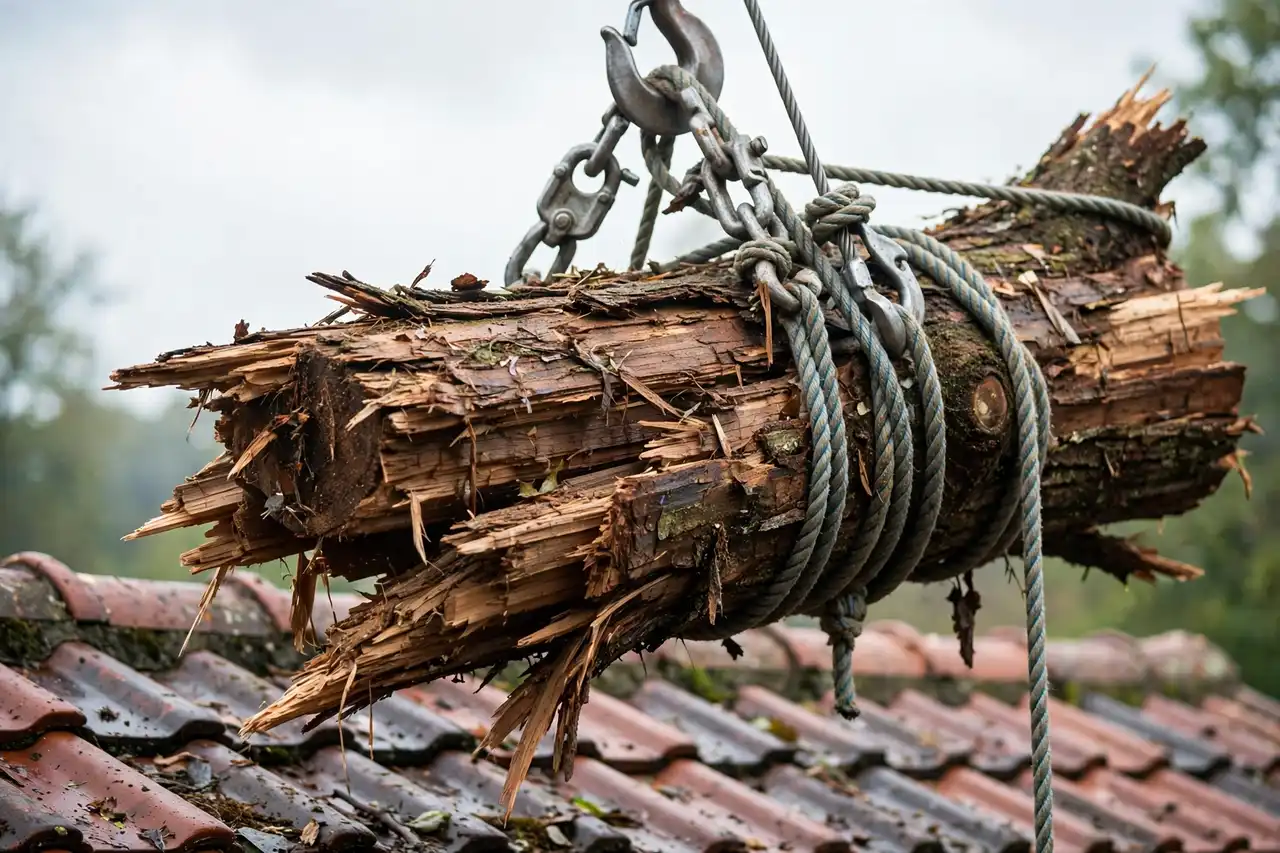
A standing tree being dismantled is a known quantity. A storm-broken tree is a loaded spring: trunks bent under other trunks, limbs twisted and held by splinters, root plates half-lifted with tons of soil in the air. Cutting the wrong piece first releases that stored energy in whatever direction physics chooses.
This is why emergency crews cut in a specific order — unloading the smallest restraining pieces last, working from the supported side, and sometimes bringing a crane to hold a section before it is cut free. It is also why the standing advice after a storm is simple: admire your luck from a distance, and keep everyone out from under damaged trees until they have been assessed.
Insurance, photos and the paperwork hour
If a tree has damaged insured property, photograph everything before it is moved — wide shots, close shots, the tree's base and the damage — provided you can do it from a safe position. Emergency crews work with insurers routinely and can document the tree's condition and the work performed.
Keep the invoice; emergency tree work to make a home safe is a standard part of storm claims, while purely cosmetic clean-up may be treated differently. Your provider cannot advise on your policy, but a clear, itemised record of what was done and why gives your insurer exactly what it needs.
After the storm: the second wave of failures
Storm damage is not always instant. Trees that were twisted, root-cracked or partially uprooted may stand for weeks before finishing the fall, often on a calm day when nobody expects it. Cracks that open and close as the tree sways, new leans, and soil lifting at the base are the tells.
A post-storm inspection of every large tree near the house — not just the obviously broken ones — is the genuinely useful follow-up. It is also the moment to schedule the preventive pruning that turns next season's emergency into a non-event.
The first visit vs. the full job
Emergency call-outs run on a two-stage logic that is worth understanding before you need it. Stage one — tonight's visit — is about safety: weight off the structure, hazard on the ground, access reopened, roof ready for tarping. Stage two, the scheduled return, handles the complete clean-up, the stump, and any other trees the storm wounded. Quotes and invoices reflect the stages separately.
This staging is not upselling; it is triage. During a regional event, crews who finished every job completely before moving on would reach a third as many houses. The make-safe visit protects your home now; the scheduled visit restores your garden properly.
Preventing the next emergency call
Almost every emergency tree has a history that an assessment would have caught: the dead top, the opening crack, the root plate softening over wet years. The pattern is so consistent that insurers and arborists share the same advice — the cheapest emergency service is the inspection that makes it unnecessary.
Concretely: have large trees near structures assessed on a cycle, act on deadwood before storm season, and treat any new lean, crack or fungus at the base as a prompt call rather than a wait-and-see. ArborReach's city pages describe the specific failure patterns of your region — they are the checklist your trees will be graded against by the weather.
Working with your insurer: the choreography
Storm claims move fastest when the paperwork is born organised: your photographs before work, the crew's itemised invoice describing hazard work in plain terms, and any police or utility reference numbers attached. Emergency providers do this weekly; a crew that documents as a matter of routine is worth choosing for exactly that reason when you have the choice.
What to avoid: signing an assignment-of-benefits or open-ended authorisation in the dark at 2 a.m. without reading it. Reputable emergency work is scoped and priced like any other — urgent, not blank-cheque. If a document would embarrass the presenter in daylight, it can wait for daylight.
The neighbourhood after a big one
Regional storms create a temporary economy: every crew booked, every chipper spoken for, prices and patience both strained. The owners who fare best are the ones with relationships — a provider who has pruned their trees for years answers their call first, and knows their property when they arrive.
It is an unfashionable argument for maintenance, but a true one: the emergency page of this website is the one we would rather you never need, and the pruning page is how you avoid it. When the next storm's queue forms, the prepared are standing in a much shorter line.
The first phone call: what the dispatcher needs
An emergency call goes faster when you can give the crew four facts: what the tree is touching (roof, car, lines, nothing yet), whether anything is still moving or creaking, whether the road or drive is blocked, and whether anyone is hurt or trapped — in which case emergency services come first and the tree crew second. Photographs help enormously: two or three phone pictures from a safe distance tell a dispatcher more than five minutes of description.
You will also be asked about access — gate widths, soft ground, whether a crane can set up in the street. Answer honestly rather than optimistically; the crew loads equipment for the job you describe, and a crane that cannot set up is a wasted hour at the worst moment. If you do not know a dimension, say so — crews would rather bring the versatile kit than the perfect kit that does not fit.
After the emergency: the quiet second phase
When the tree is off the house and the site is safe, the emergency ends but the work does not. The second phase is unglamorous and important: a proper assessment of the trees still standing (the one that failed had company, and neighbours of the same age and species deserve a look), repair of fences, lawns and beds torn up in the rescue, and the paperwork — invoices itemised for the insurer, photographs archived, the stump and debris decisions made calmly instead of at midnight.
This is also the moment to schedule prevention while the lesson is fresh. The trees that come down in the next storm are standing in your street right now, and most of them are announcing it — dead crowns, cracked unions, heaved roots. A consultation booked in the calm after a storm is the single highest-value call in tree care; it converts the next emergency into a routine visit, at routine prices, on a day of your choosing.
What drives the scope of emergency work
- What the tree is resting on. Unloading a tree from a roof or car is slow, rigged work; a tree down in open ground is straightforward cutting.
- Tension and hang-ups. Hung-up, twisted and spring-loaded material demands the most careful — therefore slowest — approach.
- Time and conditions. Night work, continuing storms and blocked access all shape what can safely be done on the first visit.
- Equipment required. Crane-assisted emergency removals are a different scope from a climbing crew with saws.
- Volume of material. One limb vs. three mature trees down is a difference in crew size and days, not minutes.
- Follow-on work. Tarping coordination, stump work and full debris removal are scoped once the site is safe.
Should you do it yourself?
Emergency tree work is the one category where the DIY answer is an unqualified no. Storm-damaged trees kill experienced professionals every year through tension release, rolling trunks and shifting root plates; for a homeowner with a hardware-store saw the odds are far worse. Your jobs in an emergency are safe ones: keep people away, call the utility if lines are involved, photograph from a distance, and make the call.
Frequently asked questions
A tree is on my power line. Who do I call?
The utility, first, always. Crews cannot safely work on a tree in contact with energised lines, and in many areas only the utility or its contractors may work within a set distance of conductors. Once the utility confirms the line is safe or de-energised, your tree service can proceed with the removal. If there is sparking, fire or a downed line on the ground, call 911 and keep everyone well back.
How fast can an emergency crew get here?
Response depends on the scale of the event. After a major storm, every crew in the region is triaging: trees on occupied houses and blocked access come first, and honest dispatchers will tell you where you are in the queue. Giving clear details and photos at the first call genuinely helps — it lets the crew arrive with the right equipment instead of making two trips.
Will insurance cover emergency tree removal?
Policies commonly cover removing a tree that has fallen on an insured structure and the work needed to prevent further damage, while a tree that falls harmlessly in the yard is often excluded. Every policy differs, so document thoroughly — photos before work starts and an itemised invoice — and speak to your insurer early. Your tree crew's role is the work and the documentation, not coverage decisions.
The tree fell but hit nothing. Is it still urgent?
It is not an emergency, but do not let it become one: a downed tree across a yard still carries tension in its limbs, attracts climbing children, and gets harder to deal with as it settles. Schedule a standard removal, and in the meantime keep people — especially kids — off it. If any part is suspended, leaning or resting on anything, treat it as urgent instead.
Can you just remove the dangerous limb and leave the tree?
Often, yes. A broken or hung-up limb can be rigged down and the tree assessed on its merits: many storm-damaged trees recover from losing one limb. What the crew will check is whether the break tore the trunk, whether the remaining structure is sound, and whether the same weakness exists elsewhere in the crown. If the tree is fundamentally sound, keeping it is the better outcome.
What should I do while waiting for the crew?
Keep everyone — including pets — away from the tree and anything it could reach if it shifts. Move cars that are not trapped. If water is coming through a roof, protect belongings inside rather than going up. Do not start cutting 'to help': partial cuts change the tension picture the crew is planning around, and can make the job more dangerous, not less.
A limb is hanging over my roof but has not fallen. Is that an emergency?
Treat it as urgent. A partially attached limb — a hanger — is a falling object whose timing nobody controls, and over a roof it belongs in the same queue as work already on the ground. Keep the rooms beneath it empty until it is dealt with, and describe it precisely when you call: 'hanging limb over the roof' gets you triaged correctly.
Can an emergency crew work in the dark or in rain?
Crews do work at night with lighting rigs when the situation requires it, and light rain does not stop make-safe work. What stops work is active lightning, winds still strong enough to move material unpredictably, and flooding or ice that makes the site itself unsafe. A dispatcher who says 'first light, when it is safe' is protecting your property as much as their crew — a botched night cut can do more damage than the tree did.
Emergency Tree Service in top metro areas
Related services
Need emergency tree service? Talk to a local professional
One call connects you with an independent tree service in your area — for an assessment, a quote, or urgent help with a dangerous tree.
Call NowArborReach USA is a referral service. We connect property owners with independent local tree care professionals; we do not perform tree work ourselves.