About this service
Tree removal is the service nobody schedules happily, and it is usually the right call anyway. A tree that is dead, structurally unsound, growing into a structure, or declining past the point where treatment makes sense does not get safer with time — it gets heavier, brittler and closer to whatever stands under it. Professional removal takes that tree down in controlled pieces, on the crew's terms, instead of waiting for weather to do it on the storm's terms.
Through ArborReach USA, one call connects you with an independent local tree service in your area that handles removals of every size: single backyard hardwoods, pines leaning over roofs, storm-broken stems, and multi-tree clearances. This page explains how to recognise a tree that needs to come out, how a professional removal actually works step by step, what drives the scope of the job, and the questions worth asking before anyone starts a saw.
Signs a tree should be removed, not saved
- The tree is dead or mostly dead. A canopy that never leafed out, bark sloughing off in sheets, and brittle twigs that snap dry are end-stage signs. Dead trees lose structural strength quickly and become unpredictable to climb and to fell.
- A lean that is getting worse. A long-standing lean with good root flare can be stable; a new or increasing lean, especially with heaved or cracked soil on the opposite side, points to root failure in progress.
- Cracks, cavities and fungal conks. Vertical trunk cracks, deep cavities, and shelf fungi (conks) at the base all signal internal decay. By the time decay shows outside, the sound wood inside may be a thin shell.
- Storm damage beyond repair. A tree that has lost its leader or more than half its crown rarely recovers a safe structure. Split crotches and hung-up limbs add urgency.
- Roots are damaging the property. Roots lifting slabs, invading sewer lines or undermining foundations sometimes make removal the only durable fix, particularly where root pruning would destabilise the tree.
- It is the wrong tree in the wrong place. Fast-growing species planted under lines or a few feet from the house become recurring hazards. Planned removal and replacement beats decades of emergency calls.
How the work runs
Assessment and plan
The visit starts with a walk-around: species, size, lean, defects, targets underneath, and access for equipment. From that, the crew decides between felling in an open drop zone or dismantling the tree in pieces.
Permits and utilities checked
Many cities protect certain trees by size or species and require a permit before removal. Lines are identified too — work near energised conductors may need the utility's involvement first.
Site preparation
Drop zones are cleared, fragile plantings and garden features are protected or moved, and the crew briefs the plan: who climbs, who rigs, who runs the ground.
Sectional dismantling
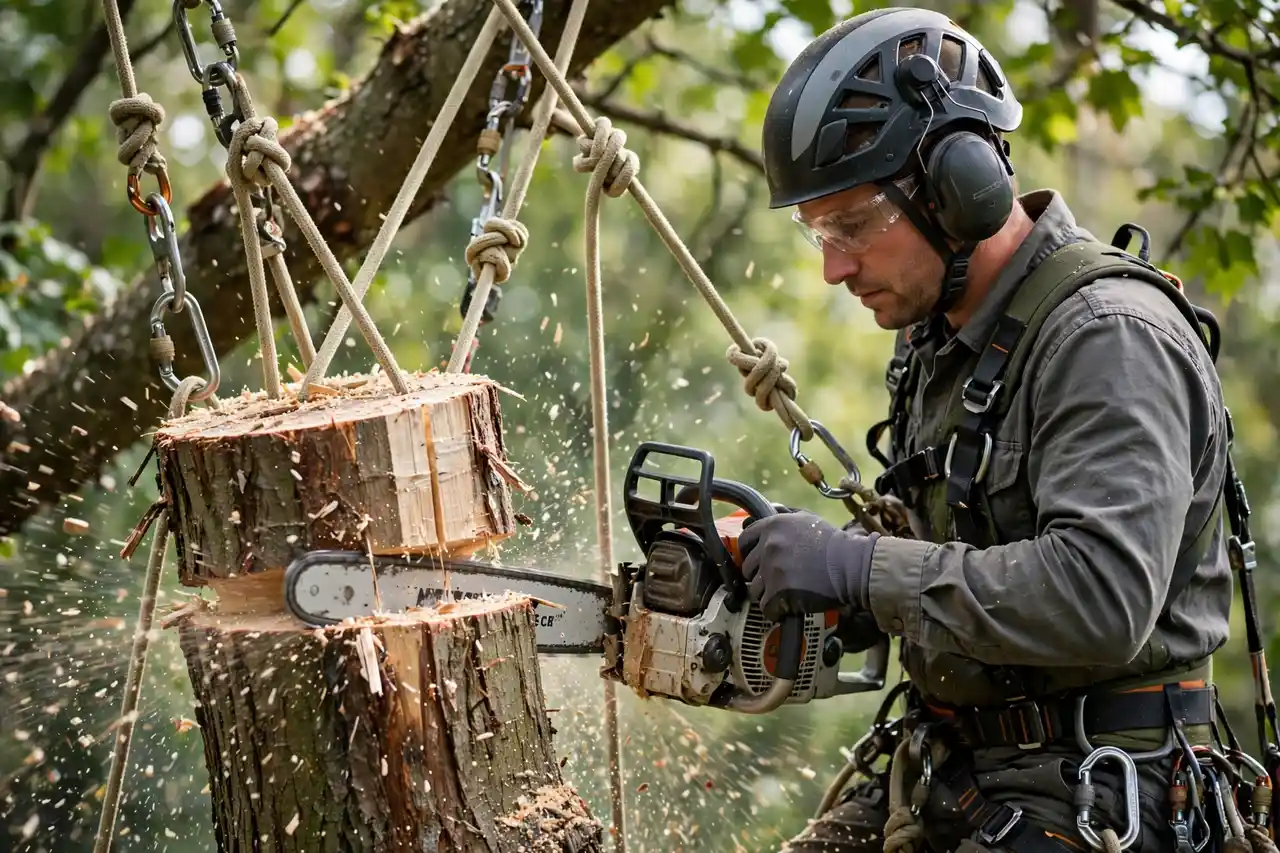
Where space is tight, a climber or lift removes the canopy in rigged sections, lowering each piece on ropes so nothing free-falls toward roofs, fences or gardens below.
Trunk removal
Once the canopy is down, the trunk is cut in rounds from the top down — or felled whole where the drop zone allows — and processed into logs, chips or firewood lengths as agreed.
Stump decision and clean-up
The stump can be ground the same visit or left for a separate stump service. Debris is chipped, hauled or stacked per the agreement, and the site is raked and blown clear.
In detail
Felling vs. dismantling: how the method is chosen
Whole-tree felling — cutting a notch and back-cut and letting the tree fall in one piece — is the fastest method, but it needs a clear drop zone roughly the tree's height in the fall direction, plus room for the bounce and roll. In open lots and rural properties it is still the standard approach.
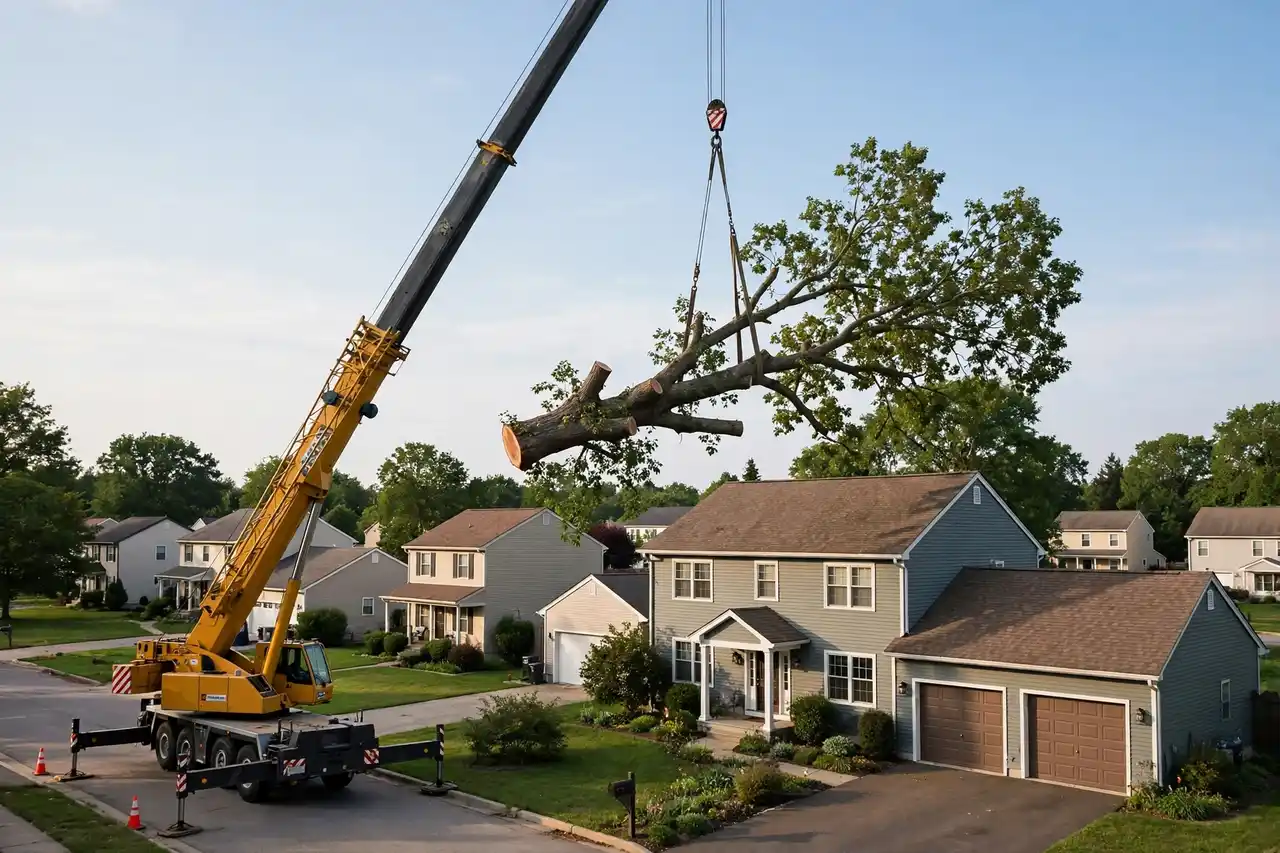
Most suburban removals are dismantles. The climber works down from the top, cutting manageable sections and lowering them on rigging ropes through pulleys anchored in the tree itself. Where even that is too tight — a tree over a glass roof, for instance — a crane lifts sections out whole. The method is chosen by the space and the targets, not by preference, and it is the main reason one removal can be a two-hour job and its neighbour an all-day rigging exercise.
What happens to the wood
Removal agreements differ on the wood, and it is worth deciding before the crew arrives. The common options are full haul-away (everything leaves on the truck), chipping on site with the mulch left for your beds, or leaving cut firewood lengths stacked where they fall — the least handling, and the option many owners choose for a tree they are sorry to lose.
If you keep wood, ask that it be cut to stove length and stacked clear of the house: piles against siding invite termites and carpenter ants in many regions. Diseased wood — from oak wilt areas, for example — may need to be removed from the property entirely rather than kept, and a good crew will tell you when that applies.
Permits, protected trees and neighbours
Heritage and ordinance trees are a real part of this work in much of the country: many municipalities require a permit — and sometimes a replacement planting — before a healthy tree above a certain trunk diameter comes down. The time to discover that is before the saw starts, not when a neighbour calls the city.
Boundary trees deserve a conversation too. A trunk straddling a property line usually belongs to both owners, and removing it without agreement creates exactly the dispute everyone wants to avoid. Your local provider can tell you what your city requires; ArborReach's city and county pages flag where permit culture is common.
Removal day: what to expect as the owner
A removal visit has a rhythm worth knowing in advance. The crew arrives with more equipment than the tree seems to need, walks the site once more, and confirms the plan — including where wood and chips will go — before the first cut. Protect anything fragile near the drop zones, keep pets inside, and expect noise in bursts rather than continuously.
By the end, the change in light is the thing owners remark on: a removed tree opens a garden more than memory suggests. If a replacement is planned, the same visit is the time to discuss species and position — the crew has just spent hours learning your site's sun, soil and space, which makes their planting advice unusually well informed.
After the removal: the first season
The stump decision you made — grind, excavate or leave — sets the first season's work. Ground stumps settle and want a top-up of soil; excavated spots want the same, in a larger size. Roots left in the ground begin their slow decay, and mushrooms appearing along old root lines the following autumn are normal, not a new infestation.
Watch the neighbouring trees for a season. Trees that shared wind shelter and root space with the removed one sometimes respond — a lean that develops, dieback on the newly exposed side. A quick follow-up assessment catches these early, when the fixes are small.
Hazardous removals: trees in the worst positions
Every area has its hall of fame: the dead pine leaning over the only power drop, the oak whose trunk straddles a septic tank, the storm-split maple suspended in its neighbour. These removals are planned like small engineering projects — load paths drawn, rigging points chosen in sound wood or in neighbouring trees, sometimes a crane booked because no safe anchor exists in the tree itself.
The owner's part in such jobs is mostly patience: they take the time they take. What you should hear at the quote visit is a method, not just a number — how the pieces come down, where they land, what could go wrong and what the crew does about it. A provider who can narrate the plan owns the job; one who waves at the tree and names a figure is guessing with your roof as the stake.
Removal and the rest of the garden
A large removal changes more than the skyline: the shade map of the whole property redraws itself. Beds planted for shade find themselves in full sun; the lawn under the canopy, thin for years, can suddenly thrive; the neighbouring tree that leaned toward the light now stands exposed to wind it never met before.
Good removal advice includes this aftermath. Providers may suggest which plantings will need moving or extra water, whether the exposed neighbour needs its own assessment, and where a replacement tree would do the most good — often not in the old tree's hole. The stump conversation and the next-tree conversation belong in the same visit.
After the tree is down: the week that follows
A finished removal leaves three things behind: a stump decision, a debris decision and a patch of ground that wants attention. Wood you kept for firewood should be stacked off the ground and away from the house — a fresh woodpile against a wall is an invitation to carpenter ants and termites, and green wood needs a season of drying before it burns cleanly anyway. The sawdust and chip scatter settle within a couple of weeks; rake the excess into beds as mulch rather than bagging it, since a thin layer feeds the soil instead of smothering it.
If the tree came down because it was diseased, ask the crew chief what the diagnosis was before you plant a replacement: some soil-borne problems argue for a different species or a different spot entirely, and planting the same species into the same infected ground is the most common way a replacement tree fails young. Where the old tree shaded the house or the lawn, expect a season of adjustment — turf that lived in shade thins in full sun, and south- and west-facing rooms run warmer until the new canopy grows in. None of it is a problem, but knowing it is coming beats being surprised by it.
Removal versus the alternatives, one last check
Before the work order is signed, it is worth one honest pass through the alternatives, because removal is the one tree decision that cannot be undone. A structurally sound tree with a fixable problem — a correctable lean, a cable-able split, a treatable pest outbreak — often deserves the fix; a tree whose trunk is hollow, whose roots have heaved the foundation, or whose species is failing site-wide in your area usually does not. The consultation exists precisely to draw that line with evidence rather than opinion.
A practical way to decide: ask what the tree will cost you over the next five years in each scenario — maintenance and monitoring to keep it, against removal and replacement now. Keep a healthy tree and the spending is modest and spread out; keep a dying one and the spending arrives anyway, later, as an emergency. Remove it, and the money goes once, on your schedule. There is no universally right answer, but there is always a cheapest honest one, and it is rarely 'wait until it falls'.
What drives the scope (and quote) of a removal
- Tree height and trunk diameter. Bigger trees mean more rigging, more cuts, more debris and more time aloft. Height is the single strongest driver of removal scope.
- Canopy spread and structure. A broad, multi-stemmed hardwood over a house is many more rigged pieces than a straight pine of the same height.
- Access for equipment. A bucket truck or crane that can reach the tree changes everything. A backyard tree reachable only through a narrow gate is hand-work from start to finish.
- Proximity to structures and lines. Work slows down — correctly — when every piece must be lowered on a rope past a roof, a pool or a service drop.
- Tree condition. Dead and decayed trees are more dangerous to climb and can require a lift or crane instead, which changes the crew and equipment plan.
- Debris handling. Hauling everything away costs more crew time than leaving chips or firewood. Stump grinding, if bundled, is scoped separately.
Should you do it yourself?
Removing anything larger than a sapling is consistently ranked among the most dangerous jobs in the country, and the failure modes — a trunk that rolls off the stump the wrong way, a limb that springs back, a saw that kicks — do not forgive learning on the job. The specific traps are well known: trees under tension ('widow-makers' hung up in the canopy), dead tops that shed pieces when the trunk is struck, and spring poles that release stored energy when cut. If the tree can reach anything you care about, it is a professional job.
Frequently asked questions
Do I need a permit to remove a tree on my own property?
It depends entirely on your city and the tree. Many municipalities protect trees above a certain trunk diameter, native or heritage species, and trees in front yards or easements — and some require a permit even for dead trees. Your local provider will know the local ordinance; ArborReach's county pages note where permit culture is common. When in doubt, check with the city before the work, because fines for unpermitted removal can exceed the cost of the job.
Can a tree close to my house be removed safely?
Yes — close quarters are the normal case, not the exception. Crews dismantle such trees in small rigged sections, lowering every piece on ropes, and use cranes where even rigging space is limited. What matters is that the plan is made before cutting starts: targets identified, drop zones agreed, and fragile features protected or moved.
What happens to the stump?
The stump is a separate decision. It can be ground below soil level the same day (see our stump grinding page), removed entirely with excavation, or left in place. Leaving it is cheapest but means no replanting in that spot and years of slow decay. Most owners who plan to replant or re-turf the area choose grinding.
Will removal damage my lawn and garden?
Some footprint is unavoidable — heavy wood comes down and equipment moves — but professional crews minimise it with rigging instead of free-falling pieces, plywood paths for equipment, and a full rake-and-blow clean-up. Tell the crew about irrigation lines, septic components and prized plantings during the assessment so they can be marked and protected.
My tree fell in a storm. Is that an emergency removal?
If a tree or large limb is on a roof, blocking access, resting on a vehicle or tangled with a service line, treat it as an emergency: keep people and pets clear, call your utility first if lines are involved, then call for emergency tree service. If the tree is down in open yard with nothing under it, it is urgent but not an emergency, and a standard removal visit will handle it.
Should I try to save the tree instead?
Sometimes, yes — cabling and bracing, corrective pruning or plant health care can give a valued tree years of safe life, and an honest assessment will say so. Removal is the recommendation when structure is gone, decay is advanced, or the risk under the tree cannot be managed. Ask the assessing arborist what saving it would involve; if the answer is vague, get a second opinion before deciding.
How long does a tree removal take?
A small, clear tree can be down, processed and cleaned up in a couple of hours. A large dismantle over a house is a full day; a crane job or a multi-tree removal runs longer and is scheduled as such. Your quote visit will give you a realistic window — honest crews estimate in half-days and days, not in optimistic hours, because rigging work refuses to be hurried safely.
Can you remove a tree in winter?
Yes — winter is often the best season for planned removals: dormant trees carry no canopy weight of leaves, frozen or firm ground takes equipment better, and gardens are resting, so the footprint matters less. The constraints are weather days and, in the coldest regions, access. Many owners deliberately schedule large removals in winter for exactly these reasons.
Tree Removal in top metro areas
Related services
Need tree removal? Talk to a local professional
One call connects you with an independent tree service in your area — for an assessment, a quote, or urgent help with a dangerous tree.
Call NowArborReach USA is a referral service. We connect property owners with independent local tree care professionals; we do not perform tree work ourselves.