About this service
Sometimes you do not need a crew — you need an answer. Is this tree safe? Can it be saved? What is wrong with it, what is it worth, what should happen to it before the house is sold, the addition is built, or the insurer asks questions? Arborist consultation is the professional-opinion side of tree care: structured inspection, risk assessment, written reports and management plans, delivered by a qualified arborist whose job is the advice itself.
ArborReach USA connects property owners, managers, builders and attorneys with local arborists offering consultation services. This page explains what a consultation involves, the situations that call for one, what a proper risk assessment looks like, and the difference between a sales visit and professional advice.
Situations that call for a consultation
- You are worried about a tree's safety. A lean, a crack, a fungus, a tree over the children's bedrooms — a structured risk assessment replaces worry with a rated, reasoned answer.
- Buying, selling or insuring a property. Tree condition affects value, liability and insurability; a written assessment before the transaction beats a surprise after it.
- Construction is planned near trees. Additions, drives and pools kill more trees by root damage than by felling; a pre-construction tree plan protects the keepers.
- A tree was damaged by a neighbour or storm. Appraisals using recognised methods put a defensible value on lost or damaged trees for claims and disputes.
- Managing many trees. Estates, HOAs, campuses and commercial sites need inventories and multi-year management plans, not one crisis at a time.
- A dispute needs a professional record. Boundary trees, damage claims and permit appeals call for documented findings from a qualified, independent arborist.
How the work runs
Brief and scope
The consultation starts with the question to be answered and what the answer will be used for — that decides the inspection depth and the report format.
Site inspection
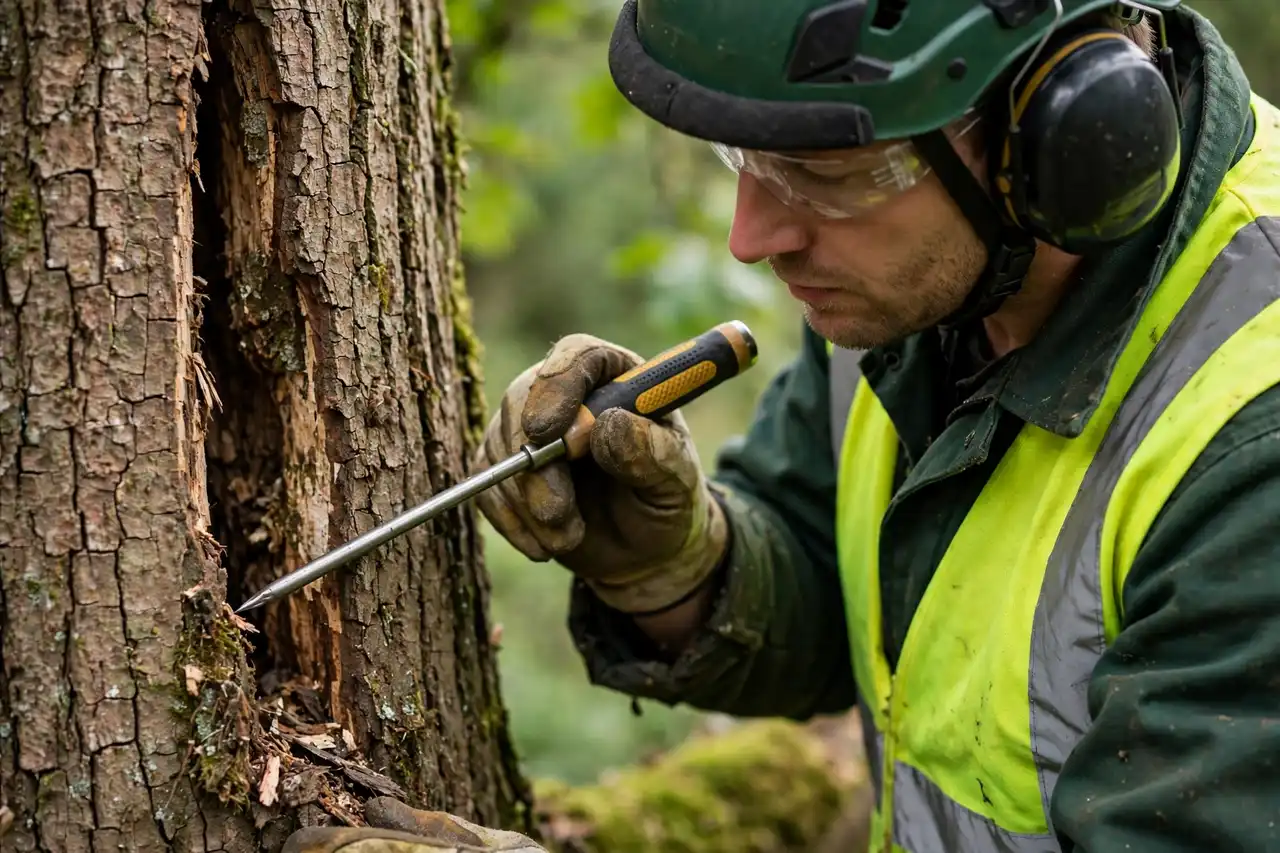
The arborist examines the tree or trees in person: structure, defects, targets, site conditions, and history — with tools from a mallet and probe to decay-detection instruments where warranted.
Risk rating
Findings are organised the professional way: likelihood of failure, likelihood of impact, and consequence — combined into a risk rating for a defined time frame.
Options and recommendations
Each option — monitor, prune, support, treat, remove — is presented with its reasoning, so the decision is yours but the thinking is done.
Written report
A clear report documents findings, photographs, ratings and recommendations in a form insurers, councils, buyers and courts can work with.
Follow-through
Where the report recommends work or monitoring, a schedule is set — and ArborReach can connect you with the service side to carry it out.
In detail
How tree risk is actually assessed
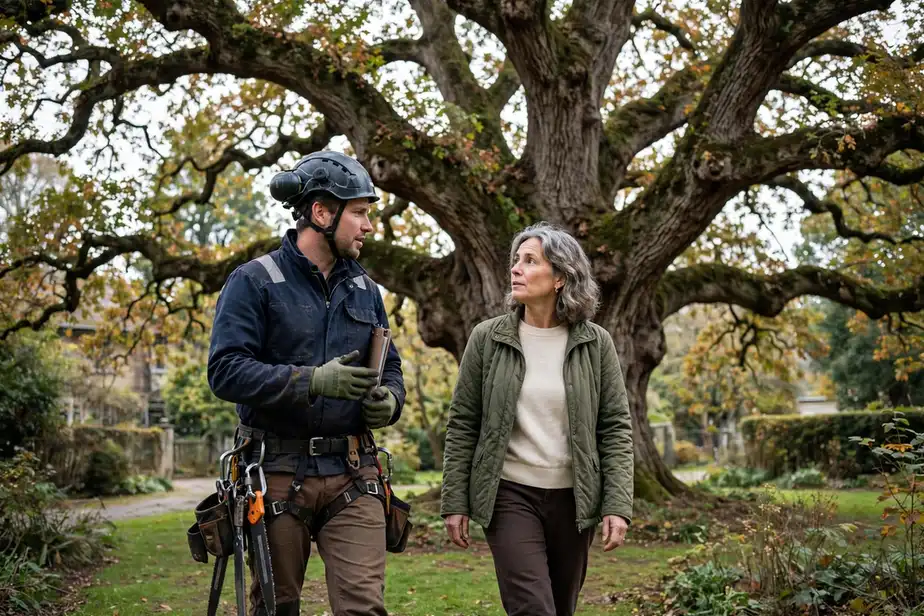
Professional risk assessment is not a glance and a shrug. The assessor identifies defects (decay, cracks, weak unions, root problems), estimates the likelihood of each failing within a stated period, weighs what stands in the fall zone and how often it is occupied, and combines those into a risk rating with recommended actions and timeframes.
The target matters as much as the tree: the same defective oak is a different risk over a woodland path and over a nursery school playground. A report that does not discuss targets, time frames and options — only a verdict — is not a risk assessment, whatever it calls itself.
Consulting vs. the free estimate
A free estimate answers 'what would you charge to do X?' A consultation answers 'what should be done, and why?' — by someone paid for the answer, not the work. That independence is the point: the consultant who will not profit from the removal can be trusted when they recommend it, and trusted more when they do not.
Many arborists do both kinds of work, and there is nothing wrong with a service company's assessment. But for high-stakes questions — heritage trees, disputes, valuable properties, construction plans — commissioning the advice separately, in writing, is how the other professions handle it, and trees deserve the same seriousness.
Tree appraisal: what a tree is worth
When a tree is destroyed or damaged — by a vehicle, a neighbour's contractor, a fire — its value is not a guess. The industry's standard appraisal method (the CTLA trunk-formula approach) builds value from the tree's size, species, condition and location, and it is the method insurers and courts recognise.
Appraisal has limits worth knowing: it values landscape trees, not timber, and it cannot resurrect a bad planting decision. But for a mature shade tree shading a home — a loss measured in decades, not seasons — a proper appraisal usually surprises owners by how much of their property's value was standing in the garden.
Construction and trees: the protection plan
More fine trees are killed by kindness-adjacent construction — the new drive routed 'just past' the trunk, the grade raised 'only a few inches' over the roots — than by any disease. A tree protection plan prevents it on paper: root-protection zones calculated from trunk diameter, fencing that actually excludes machines, ground protection where crossing is unavoidable, and specified methods for the trench that must cross roots.
The arborist's construction role runs in three visits: before (assess and specify), during (inspect the protection and any root work), and after (assess the damage you cannot yet see — construction decline typically declares itself over the following three years, and the documentation trail starts at the first visit).
Tree inventories: knowing what you own
For estates, HOAs, schools and landowners with woodland edges, the inventory is the foundational document: every significant tree mapped, speciated, measured, condition-rated and action-flagged. It converts tree management from folklore ('the big one by the gate looks off') into a dataset that budgets, insurers and boards can act on.
Modern inventories live in software the owner keeps — not in the consultant's drawer — and are refreshed on the inspection cycle. If you are commissioning one, specify that the data is yours, exportable, and rated on a recognised scale; an inventory you cannot take to another provider is a subscription, not a survey.
Consultation for sellers, buyers and the simply curious
Transactions concentrate the mind: a buyer's survey that flags 'large tree near house' is an opinion in search of a professional one, and a seller armed with a recent arborist report answers it before it is asked. Consultation in a transaction is priced clarity — the tree is safe and here is the document, or the tree needs work and here is its scope, either of which moves a negotiation better than anxiety does.
The simply curious are legitimate clients too. A mature tree you have owned for twenty years deserves one professional hour spent purely on understanding it: its species, its condition, its likely future, its care calendar. Owners consistently describe that visit as the best-value hour in their garden's life.
What a consultant will not do
Professional consultation has boundaries worth knowing. A consultant will not condemn a neighbour's tree in a report meant to force its removal — they will document condition and risk, and let the evidence speak. They will not certify a tree 'safe' in absolute terms; living structures in weather do not admit that word, and reports are written in ratings and timeframes instead.
Nor will they price another company's work, design around a conclusion you have supplied, or inspect from photographs for a formal opinion. These refusals are not preciousness — they are what makes the documents they do produce worth relying on, in front of insurers, councils and courts.
What to do with the report you receive
A consultation report is only worth its fee if it changes what happens next. Read it for the action list: which items are safety items (this season, no debate), which are health items (this year, scheduled), and which are observations (watch, photograph, revisit). A good report separates those tiers clearly and attaches honest timeframes, because 'everything is urgent' is a sales posture, not an assessment.
File the report with the house documents and diarise the monitoring items — a crack to re-measure in twelve months only gets re-measured if something reminds you. When you commission follow-up work, give the crew the report: it is the baseline their work is judged against, and firms that know their work will be compared to a written assessment tend to work to it. At sale time, the report and its completed action list are a genuine asset in the disclosure pack.
Consultants versus sales visits, and why both exist
There is nothing wrong with a free estimate from a firm that hopes to do the work — it is the industry's normal front door, and most are honest. The consultation earns its fee in the cases where the incentives matter: when the recommended work is expensive, when two firms disagree, when a tree's fate is disputed between neighbours or an HOA, or when the document itself has an audience — an insurer, a court, a buyer, a planning hearing.
Think of it as the difference between a quote and a diagnosis. You would not let the firm selling the surgery be the only voice on whether you need it; trees deserve the same courtesy when the numbers get large. And because a consultation is paid, it is also the one visit where asking naive questions costs nothing in obligation — use it to learn your own trees. Owners consistently say the hour of education was worth as much as the report.
What drives the scope of a consultation
- Number of trees and site size. One garden tree vs. a campus inventory are different commissions entirely.
- Question complexity. A safety opinion, a construction protection plan and a court-ready appraisal are ascending levels of work.
- Diagnostic depth. Basic visual assessment vs. advanced decay detection, aerial inspection or laboratory analysis.
- Report requirements. A letter of findings vs. a formal report with ratings, maps and photographs for third parties.
- Urgency and audience. Transaction deadlines, insurer requirements and legal proceedings shape the deliverable.
- Follow-up. Monitoring schedules, re-inspections and plan updates over multiple years.
Should you do it yourself?
You can — and should — do your own informal tree watching: photograph your big trees each year from the same spots, note new leans, cracks, fungi and dieback, and keep the file. That habit makes you a better client. What it cannot produce is a defensible professional opinion: risk ratings, appraisals and reports that insurers, councils and courts accept must come from a qualified arborist who inspected in person. Knowing when the question needs that weight is the judgement this page exists to support.
Frequently asked questions
What is the difference between an arborist consultation and a free estimate?
An estimate prices work you have already decided on. A consultation decides what work — if any — is warranted, and documents why. Consultations are paid advice, independent of any crew's sales interest, and produce a written record you can use with insurers, buyers, councils or courts. For a routine removal, an estimate suffices; for safety worries, disputes, transactions and construction, commission the consultation.
What qualifications should a consulting arborist have?
Look for ISA Certified Arborist credentials as the baseline, and for risk work specifically, the ISA Tree Risk Assessment Qualification (TRAQ). Consulting arborists may also belong to the American Society of Consulting Arborists. Experience with your region's species and problems matters as much as letters — ask what similar assessments they have done.
What will I receive after a risk assessment?
A written report covering the tree's condition and defects, photographs, the risk rating with its reasoning (failure likelihood, targets, consequences, time frame), and recommended actions with priorities. If the recommendation is removal of a tree you love, the report should make the reasoning plain enough to check — and you are entitled to a second opinion before acting.
Can an arborist tell me what my tree is worth?
Yes — landscape tree appraisal is an established discipline using the CTLA trunk formula, which builds value from trunk size, species rating, condition and location. It is used for insurance claims, damage cases and tax-relevant losses. It applies to landscape trees in place, not to timber or to trees already dead and valueless as amenities.
I am building an extension. When should the arborist visit?
Before the plans are finalised — ideally before they are drawn. A pre-construction assessment identifies which trees can survive the work, sets root-protection zones, and specifies fencing, ground protection and pruning. Retrofitting tree protection after footings are dug is the expensive, usually futile version of the same conversation.
My neighbour's tree worries me. Can you assess it?
An arborist can assess what is visible from your property and advise you, but cannot enter or treat a neighbour's tree without their involvement. The productive route is a conversation backed by information: many owners act once they see a written professional concern. If risk is serious and the owner will not engage, your local authority or insurer can advise on the formal channels — documentation you already have will matter.
Can a consultation be done from photographs?
Photographs help a consultant decide whether a visit is worthwhile and what it should examine, but a professional opinion — a risk rating, an appraisal, a report others will rely on — requires the in-person inspection: the base, the soil, the unions and the targets are not all visible in any photograph. Expect a reputable consultant to decline to certify from pictures alone.
How often should mature trees be re-inspected?
A common professional rhythm is every two to three years for mature trees over occupied targets, annually for trees with known defects under management, and after any major storm regardless of schedule. The interval tightens with the tree's condition and the target's value — a playground oak and a woodland oak are not on the same calendar.
Can you consult on trees at a property I do not own yet?
Yes — pre-purchase tree assessments are a standard commission, arranged with the seller's or agent's permission for access. The timing is the point: findings land while the transaction can still absorb them, whether that means a price conversation, a work plan for after completion, or simply peace of mind that the great oak over the roof is sound. If you are the seller, commissioning the same report first converts a buyer's unknown into your documented fact.
Arborist Consultation & Risk Assessment in top metro areas
Related services
Need arborist consultation & risk assessment? Talk to a local professional
One call connects you with an independent tree service in your area — for an assessment, a quote, or urgent help with a dangerous tree.
Call NowArborReach USA is a referral service. We connect property owners with independent local tree care professionals; we do not perform tree work ourselves.