About this service
Most trees do not die suddenly; they decline in chapters — a thinner crown this year, dead twigs the next, a fungus the year after — and most of those chapters have a cause that could have been treated two chapters earlier. Plant health care is the diagnostic side of tree work: identifying what is actually wrong with a tree, and applying the right treatment — soil care, targeted treatments, structural support — instead of guesswork.
ArborReach USA connects you with local arborists offering health assessments and treatment for trees and shrubs. This page explains how diagnosis works, the problems that show up most often, what treatment realistically involves, and the honest limits of what treatment can do.
Signs a tree needs a health assessment
- Thinning crown or dieback at the tips. The classic early-warning pattern: the tree is retrenching, spending less than it earns, and something below or within is wrong.
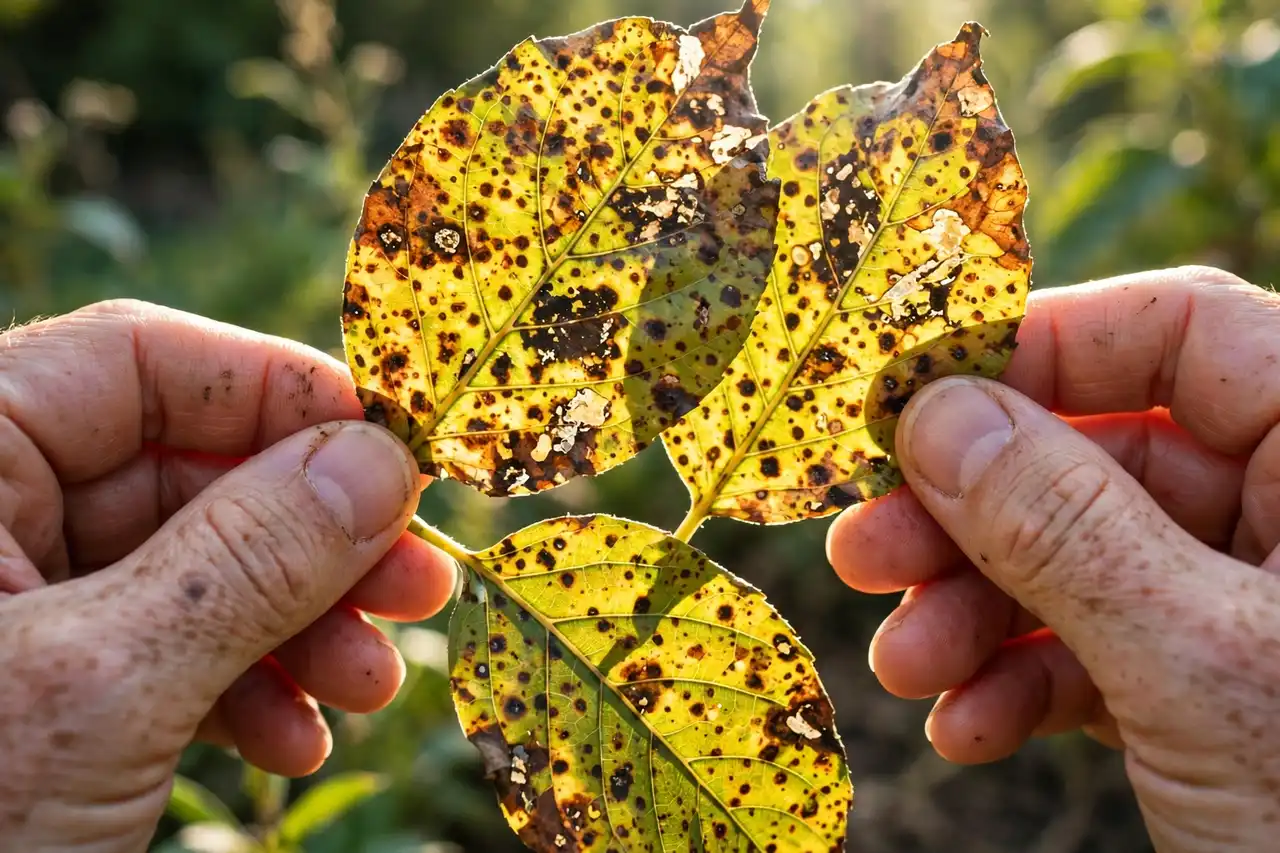
- Off-colour, small or sparse leaves. Pale, undersized foliage mid-season points to nutrient, root or vascular problems rather than weather.
- Spots, wilts and oozing on leaves or bark. Leaf spots, sudden flagging branches, bleeding cankers and sawdust-like frass are each signatures of specific diseases and borers.
- Fungal growth on trunk or roots. Conks and mushrooms at the base signal internal decay; mushrooms in the lawn along root lines tell a related story.
- Bark peeling, cracks or insect holes. Exit holes, pitch tubes and cracking bark show where insects or cankers are working under the surface.
- A tree that changed after nearby construction. Grade changes, trenching and compaction within the root zone are the most common man-made cause of slow decline.
How the work runs
History first
When did it change, what changed around it — construction, drought, a wet year, a new lawn regime? Tree diagnosis is half detective work.
Above-ground inspection
Crown density, leaf size and colour, twig growth, bark, trunk and branch unions are read like a chart, and samples are taken where needed.
Below-ground inspection
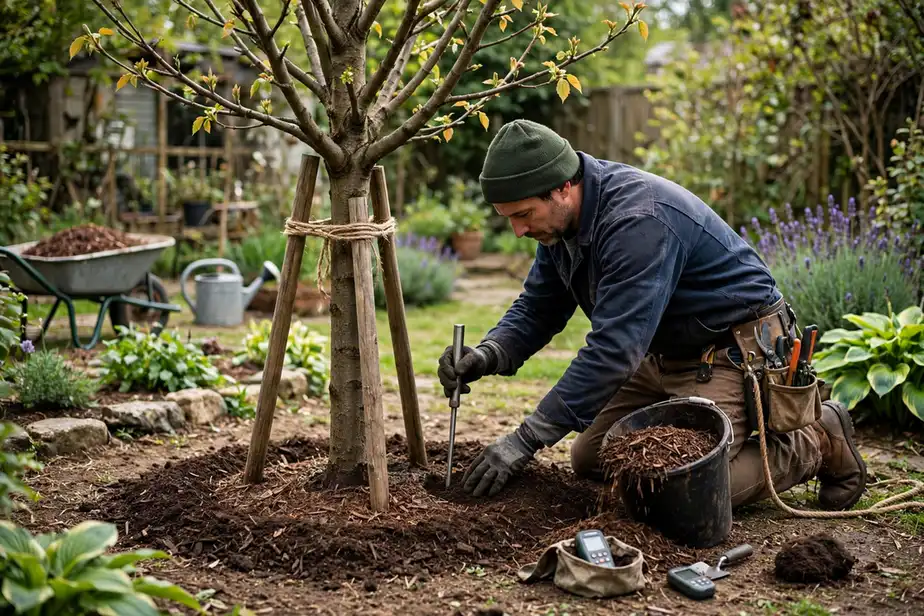
The root collar is exposed and checked (a buried flare is a diagnosis in itself), soil is assessed for compaction, drainage and pH, and roots are examined where symptoms point.
Diagnosis and options
You get a plain-language finding: what it is, how sure the diagnosis is, what treatment involves, and what happens if you do nothing.
Treatment
Depending on the finding: soil decompaction and amendment, deep-root fertilisation, targeted insect or disease treatments, watering correction, or structural work.
Monitoring
Health care is a programme, not an event — treated trees are re-checked on a cycle so response (or non-response) is caught early.
In detail
The buried root flare: the quiet epidemic
One of the most common findings in planted trees costs nothing to prevent and years to fix: the root flare — the widening at the base of the trunk — buried under soil and mulch. Planted too deep at the nursery or the site, trees slowly strangle on their own girdling roots, decline for a decade, and get treated for everything except the cause.
The fix, where the tree is young and vigorous enough, is excavation of the root collar (often with an air tool that blows soil away without cutting roots), cutting girdling roots, and regrading. It is the single most satisfying diagnosis in the field, because the tree's problem is mechanical, visible and correctable.
Treating insects and disease: timing is the treatment
Most tree treatments are won or lost on the calendar. Systemic treatments for borers must be in the tree before the flight season; fungal leaf diseases are prevented by protecting new foliage, not cured after spotting; bacterial diseases respond to sanitation and stress reduction more than to sprays.
This is why a health-care programme starts with identification, not a spray schedule. Treating for the wrong pest at the wrong time spends money, loads the garden with product, and leaves the real problem — very often soil, water or roots — untouched. Expect a good provider to sometimes recommend no product at all.
When treatment is not the answer
Honest health care includes its own limits. Advanced internal decay, vascular wilts in their late stages, root systems destroyed by construction, and trees whose structure has failed are not treatment candidates — they are removal or monitoring candidates, and money spent treating them is money spent delaying the inevitable.
The professional standard is to say so clearly, explain the reasoning, and offer the alternative (risk monitoring, reduction pruning, or removal and replanting). ArborReach's role is to connect you with providers who work that way — the assessment you can trust is the one that sometimes talks itself out of a treatment sale.
The soil is the patient: urban tree medicine's big idea
Ask arborists what changed their field most in fifty years and many will say the shovel: the realisation that most urban tree decline is a soil story. Construction compacts it, paving seals it, turf competes for it, irrigation wets the wrong part of it, and the tree — planted too deep, flare buried, roots girdling — slowly starves in the middle of apparent plenty.
That is why modern plant health care spends so much effort below ground: air-tool excavation of buried flares, radial trenching and decompaction, organic matter worked back into root zones, mulch rings replacing turf to the drip line. It is unglamorous work with a remarkable hit rate, because it treats the cause the leaf symptoms were merely reporting.
Reading a crown: what the assessor sees
A trained eye reads a crown like a chart. Dieback starting at the tips and top means the tree is spending down reserves; sparse, small leaves say the root system cannot supply a full canopy; epicormic sprouts along the trunk are emergency shoots — the tree re-leafing its own structure because the crown is failing; early autumn colour in one section flags a vascular problem in that section's supply line.
None of these signs names a culprit by itself — drought, roots, disease and insects sign their work in overlapping handwriting — but together they narrow the field before a single sample is taken. It is also why a photo rarely suffices for diagnosis: the assessor is reading the whole tree, the soil and the site history as one document.
Fertilisation: the most requested, least understood treatment
Owners ask for feeding the way they might ask for a tonic — and sometimes the tree in front of them needs exactly that. But fertiliser treats a deficiency, not a mood: applied to a tree whose real problem is compaction, buried roots or drought, it produces a flush of growth the roots cannot support and can actively worsen salt stress in tired soils.
The professional sequence runs test-first: soil analysis or clear symptom patterns justify the prescription, the formulation follows the finding, and application puts nutrients in the root zone rather than on the lawn that competes with the tree. If a provider's first suggestion for every ailing tree is a feed, ask what deficiency they have diagnosed — the question sorts the practitioners from the sales route.
Veteran trees: care in the last chapter
Old trees decline the way old athletes do — gradually, then in specific joints. Veteran care accepts the trajectory and manages it: retrenchment pruning that reduces the crown the way the tree itself is doing, deadwood retained where nothing beneath can be hurt (it is habitat of real value), soil decompaction to ease the root's old age, and monitoring that watches the structure rather than the calendar.
The goal is not immortality; it is a long, safe, dignified last chapter for a tree that may have stood for two centuries. Owners of veteran trees usually understand this instinctively — the consultation formalises it into a plan the next owner, and the next arborist, can continue.
The monitoring habit that catches everything early
Almost every expensive tree problem was a cheap problem twelve months earlier. The difference is a walk: twice a year, spring and autumn, circle each significant tree slowly and look at four things — the crown (thinning? dead tips? off-colour?), the trunk (new cracks, oozing, fungal shelves?), the base (flare visible? soil heaped? mushrooms?) and the ground (construction, grade changes, new paving?). Photograph anything odd and compare next season; change over time is the real diagnostic signal.
You do not need to identify the problem — that is the arborist's job — you only need to notice that something changed. A crown that was full in May and thin in September, a crack that lengthened, mushrooms that were not there last year: these are the triggers for a health visit while treatment is still simple. Homeowners who walk their trees spend a fraction on health care of those who meet their trees only when something falls off them.
Feeding the soil, not the tree
Modern tree health care is mostly soil care, because most urban tree decline starts below ground: compaction from foot and vehicle traffic, soil buried too deep over the flare, drought under pavement, and beds built up against the trunk. The interventions follow the diagnosis — air-spade decompaction, vertical mulching, flare excavation, irrigation planning, and organic matter worked into the root zone — and fertiliser, when used at all, is blended to a soil test rather than applied by habit.
This is why a health-care quote that begins with a product ('we recommend our standard injection package') deserves suspicion, while one that begins with findings ('compaction at 8 inches, pH 7.9, flare buried 4 inches — here is the plan for each') deserves confidence. Trees are long-lived and slow to complain; a care programme measured in findings and re-checked annually is how they stay assets instead of becoming emergencies.
What drives the scope of health care
- Diagnosis depth. A visual assessment vs. soil testing, tissue sampling or decay detection are different levels of investigation.
- Tree size and number. Treatments scale with canopy volume and trunk diameter; whole-property programmes price differently from single trees.
- Treatment type. Soil work, systemic treatments, sprays and structural support each carry their own equipment and revisit pattern.
- Programme vs. one-off. Serious problems are managed over seasons; monitoring visits are part of the scope, not an upsell.
- Access and targets. Treating a tree over a pool, playscape or organic garden changes product and method choices.
- Regional disease pressure. Active oak wilt, lethal bronzing or borer outbreaks in an area change both urgency and protocol.
Should you do it yourself?
Homeowners can do the highest-value health work themselves: proper mulch rings (wide, not volcanoed), watering deeply during drought, and keeping string trimmers and mowers off trunks. Diagnosis and treatment are where to stop — the difference between iron chlorosis, root rot and drought stress is invisible without training, treatments mistimed are simply wasted, and injecting or spraying large trees involves products and equipment that belong in professional hands. Spend DIY effort on prevention; spend professional money on diagnosis.
Frequently asked questions
My tree's leaves are turning yellow. What is wrong with it?
Yellow leaves are a symptom, not a diagnosis — the same yellowing can come from nutrient lockout in alkaline soil (chlorosis), root damage, drought stress, poor drainage, or a vascular disease. The pattern helps: which leaves, which side, since when, and what changed around the tree. That is exactly what a health assessment works through, and why treating before diagnosing so often fails.
Can a diseased tree be cured?
Some problems, yes — early-stage infections, nutrient disorders and many insect infestations respond well. Others, like established vascular wilts or advanced decay, can only be managed or slowed. A trustworthy assessment separates the two honestly and prices the realistic option. Where cure is not realistic, the money belongs in removal and a healthy replacement.
What is deep-root fertilisation, and does my tree need it?
It is the injection of fertiliser into the root zone, bypassing turf competition and surface runoff. Urban and suburban trees — growing in compacted, biologically poor soil, stripped of their natural leaf-litter recycling — genuinely benefit where soil tests or symptoms show deficiency. Trees in healthy woodland soil usually do not. The need is a soil question, not a sales question, and a good provider will test or reason before recommending.
Are treatments safe for my family, pets and garden?
Modern tree care uses targeted methods — trunk injection and soil application put product inside the tree or the root zone rather than broadcasting it — and labelled products carry specific re-entry guidance your provider will explain. Organic and cultural options (soil care, sanitation, resistant replacements) exist for many problems. Raise any concern at the assessment; the method can usually be adapted.
How long before a treated tree looks better?
Trees answer in seasons, not days. A tree treated for nutrient problems may green up within the same season; structural recovery, crown rebuilding and disease management are measured over one to three years of growth. What you should see quickly is a plan and a monitoring schedule — visible new growth and stabilised symptoms are the milestones the follow-up visits check.
A company offered to spray all my trees on a schedule. Is that normal?
Preventive programmes exist for specific high-value trees with known, recurring problems — certain crabapples and fungal leaf disease, for instance. Blanket calendar spraying of everything, without a diagnosis per tree, is not the professional standard and not how the providers ArborReach connects you with are expected to work. Ask what each treatment targets; a real programme has a named reason for every visit.
How much does a health assessment cost?
It depends on the depth commissioned — a single-tree visual assessment, a property-wide programme and laboratory-supported diagnosis are different products, and we deliberately publish no figures because the range misleads. What you are buying is a named finding and a plan; a provider should be able to describe exactly what their assessment includes before you commit to it.
My tree drops leaves every summer. Is it dying?
Mid-summer leaf drop is most often a water story — the tree shedding load it cannot supply — and by itself it is a stress signal, not a death sentence. The pattern to respect is repetition with decline: smaller leaves each spring, more dead twigs each winter, thinner crown each year. That trajectory deserves an assessment; a single dry-August sulk usually deserves a hose.
Tree Health & Disease Care in top metro areas
Related services
Need tree health & disease care? Talk to a local professional
One call connects you with an independent tree service in your area — for an assessment, a quote, or urgent help with a dangerous tree.
Call NowArborReach USA is a referral service. We connect property owners with independent local tree care professionals; we do not perform tree work ourselves.