About this service
Every mature tree shading a street was planted once — usually by someone who never sat in its shade. Planting is the optimistic end of tree care, and also the stage where the most long-term damage is done carelessly: the wrong species for the space, planted too deep, in a hole dug like a flowerpot, sets up twenty years of decline that gets blamed on everything except the planting day.
ArborReach USA connects you with local services that plant trees properly — species matched to your site and region, root flares at grade, and aftercare that gets young trees established. This page explains how professional planting works, how to choose what to plant, and the first two years that decide whether a tree thrives.
When professional planting is worth it
- Replacing a removed tree. The classic moment: the old tree is out (stump ground or removed) and the site is ready for its successor — planted right this time.
- New-build and new-owner properties. Bare lots and builder-grade landscapes are blank pages; a planned planting now is a canopy in a decade.
- Shade and energy goals. A well-placed shade tree on the west or south side is infrastructure: it cools the house every summer for generations.
- Privacy and screening. Evergreen screens planted at the right spacing solve in five years what fencing solves badly forever.
- Large or multiple specimens. Big nursery stock, balled-and-burlapped trees and multi-tree plans involve weight, equipment and warranties worth professional handling.
- Replacing losses after storms. Storm gaps in a canopy are planting opportunities — ideally with a more diverse mix than the one that failed.
How the work runs
Site and goal review
Sun, soil, drainage, space at maturity, utilities above and below, and what you want the tree to do — shade, screen, fruit, fall colour — come before species names.
Species selection
From the site facts, a shortlist of species and cultivars that fit the space, the region and your maintenance appetite — diversity strongly favoured over repeating the street's one species.
Stock inspection
The nursery tree is checked like a patient: root flare visible, trunk taper sound, no girdling roots circling in the pot, healthy crown structure started.
The planting
A wide, shallow hole — two to three times the root ball's width, no deeper than the flare — backfilled with the native soil, watered in to settle, and finished with the flare at or slightly above grade.
Mulch and support
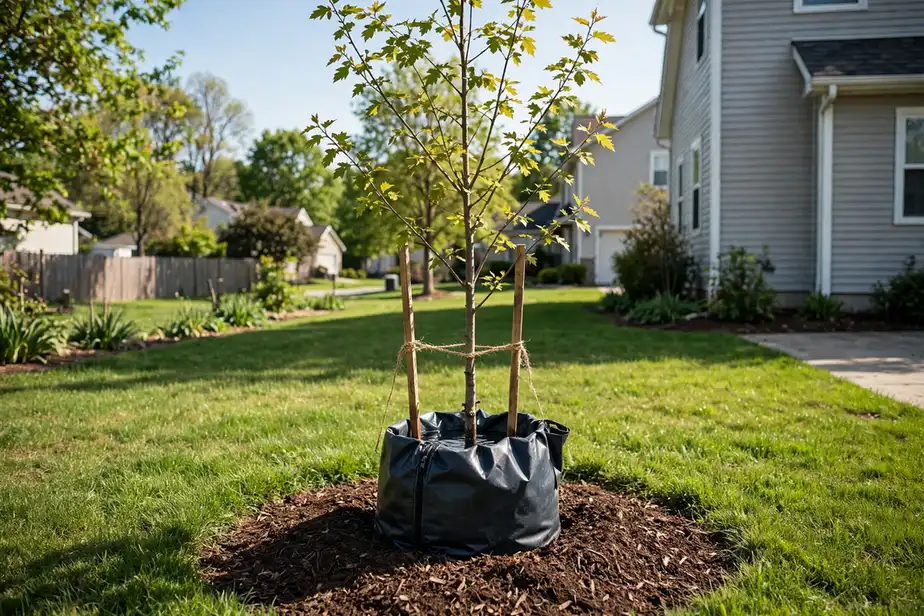
A wide mulch ring (never a volcano against the trunk), staking only where the site genuinely requires it, and a watering plan for the first seasons.
Establishment care
Scheduled deep watering through the first two growing seasons, a mulch refresh, formative pruning after establishment, and a check that stakes and ties come off on time.
In detail
Right tree, right place: the only rule that matters
Nearly every mature-tree problem brought to an arborist began as a planting decision: the species that grows to sixty feet under a power line, the water-hungry tree in dry soil, the sun-lover in a shadowed courtyard. Mature size — not nursery size — is the number that matters, along with soil volume; a large-canopy tree in a tiny soil pocket is a slow-motion failure.
Regional fit matters just as much: the right species for a Minnesota street and a Miami garden share almost nothing. ArborReach's city pages describe your region's proven canopy species, and local providers plant what survives locally — the nursery's national bestseller list is not a planting plan.
Planted too deep: the mistake underground
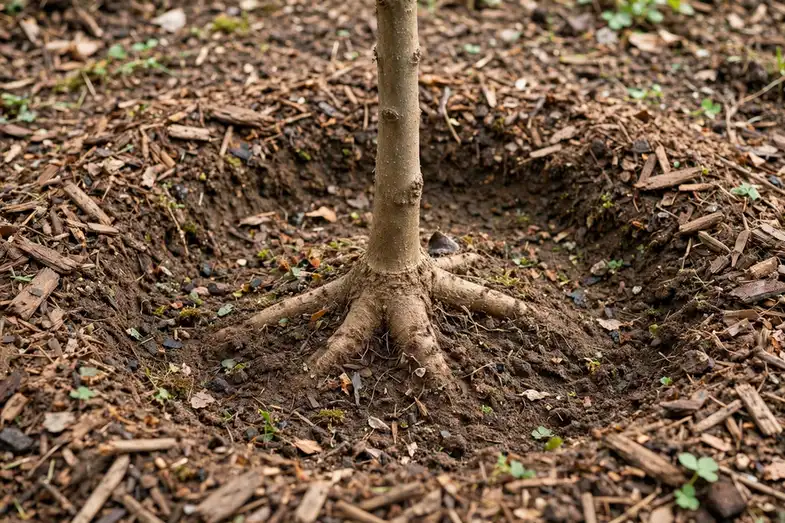
The single most common planting defect is depth. When the root flare sits below grade — buried in the nursery container, then buried again at planting — the trunk stays wet, girdling roots develop, and the tree declines on a ten-year fuse. Correcting it later means excavation; preventing it takes thirty seconds and a trowel at planting time.
The finished picture to expect: flare visible at the surface like the base of a wine glass, mulch pulled back from the trunk itself, and a hole you could describe as a wide saucer rather than a bucket. If a planting crew's finished work shows a trunk rising straight out of mulch like a lollipop, ask them to show you the flare.
The first two years: establishment
A transplanted tree has lost most of its fine roots and lives on stored energy and your watering can until it re-establishes — roughly a year per inch of trunk diameter. Deep, infrequent watering that soaks the root zone beats daily sprinkles; mulch does more for establishment than any fertiliser; and fertiliser at planting is usually unnecessary and occasionally harmful.
Formative pruning waits until the tree is established, then starts the light structural corrections that prevent the co-dominant stems and crossing limbs the next generation of arborists will cable and cut. Planting well is not an event, it is a two-year light-touch programme — and it is the cheapest tree care there is.
Nursery stock: choosing the tree, not the pot
The most consequential inspection in planting happens before money changes hands, at the nursery. Good stock shows its root flare at the soil surface — dig with a finger if you must; a trunk that enters the soil like a pole is already planted too deep in its pot. The trunk should taper, the crown should show the beginnings of a sound structure, and circling roots visible at the pot's edge are a warning, not a detail.
Container trees can be root-corrected at planting — shaving the outer root ball and teasing out girdlers — which a professional crew does as routine. Balled-and-burlapped stock trades that flexibility for size. Either way, the tree you reject at the nursery is the cheapest problem you will ever avoid in tree care.
Planting for the climate you are getting
Species selection used to be a look-up in a hardiness table; it is becoming a forecast. Trees planted today will live in the climate of the next fifty years, not the last — hotter summers in most regions, stranger rainfall almost everywhere. Choosing species with tolerance margins beyond your current zone, and planting a diverse mix rather than a monoculture, is the profession's answer.
Your ArborReach city page's climate figures are the local starting point — the heat days and rainfall your new tree must be built for. Local providers plant what demonstrably survives locally; weight their shortlist accordingly, and be sceptical of any species being planted everywhere regardless of place.
Street trees and shared canopy
The tree you plant in a front garden or a verge strip is partly a public act: it shades the pavement, cools the street, and joins a canopy whose benefits the whole neighbourhood draws on. Many cities run street-tree programmes with approved species lists and sometimes shared costs — worth a call before planting near the kerb, both for permission and for the free local knowledge.
Street conditions are the hardest school: reflected heat, compacted soil, road salt in the north, car doors everywhere. Species that thrive there — and there are proven lists for every region — are not always the species that charm at the nursery. Your city page's profile names your region's proven street performers.
Planting in memory, in honour, in replacement
A significant share of planting is commemorative: for a parent, a child, a pet, an anniversary — or to replace the great tree whose removal left the garden echoing. Providers who do this work regularly understand the brief instinctively, and can help with the practical poetry: species that live long, flower at the right season, or carry a regional meaning.
If the planting replaces a removed giant, one technical note from the removal page bears repeating: the new tree does not have to go in the old hole, and usually should not. A few feet away there is fresh soil and a clear root run — the successor deserves its own ground.
The first two years decide the next fifty
A newly planted tree is not established — it is a patient in recovery, living on the roots it arrived with while it grows new ones into your soil. The work of the first two years is almost entirely water and mulch: deep watering on a schedule matched to species and season, a wide mulch ring kept off the trunk, and stakes removed once the tree stands on its own, usually after the first year. Trees babied correctly for two seasons then need almost nothing for decades; trees neglected in year one rarely catch up.
Watch for the two classic mistakes in other people's plantings and avoid them in yours: the mulch volcano, soil and mulch heaped against the trunk until the flare rots, and the forgotten stake, whose ties girdle the trunk as it thickens. Both are epidemic in new developments and both are free to prevent. If a landscaper maintains your beds, make sure their mulch crew knows the rings stay flat and wide — most planting failures in cared-for gardens are maintenance accidents, not planting errors.
Choosing the tree: a short decision method
Decide in this order and the choice nearly makes itself. First, the space at maturity — height, spread and root room — because no pruning regime fixes a tree that outgrows its site. Second, the soil and water you actually have, matched against species tolerances: a tree that loves your conditions needs no life support. Third, the job you want done — shade on the west wall, screening, spring flowers, wildlife value, a statement at the front door. Only then, fourth, pick the specific tree, favouring species with a track record in your town over novelties.
Local evidence beats catalogue copy every time: the species lining your older streets, thriving at thirty years old in the same soil and weather, are proven choices; the fashionable import with no local adults is a gamble. A good planting consultation walks your site through exactly these four steps and lands on two or three candidates with honest trade-offs, rather than a single pushed favourite.
What drives the scope of a planting job
- Size and number of trees. Container saplings vs. large balled-and-burlapped specimens are different logistics entirely.
- Access and soil. Rock, clay, slopes and gated backyards change the digging and delivery plan.
- Site preparation. Old stump removal, soil amendment and drainage work may precede the planting itself.
- Stock quality. Larger caliper and better-formed nursery stock costs more at the nursery and gives years of head start.
- Aftercare included. Watering visits, mulch refresh and formative pruning in the establishment period are scope worth agreeing up front.
- Guarantee or warranty terms. Some providers warranty establishment under their aftercare — a real differentiator worth asking about.
Should you do it yourself?
Planting a small container tree is one of gardening's genuine pleasures and perfectly reasonable DIY — if you learn the three things that matter: dig wide and shallow, find the flare and set it at grade, and water deeply through two seasons. Where DIY goes wrong is almost never effort; it is depth and species choice. For large stock, multiple trees, or anywhere the tree's mature size matters to a structure, professional planting earns its cost on day one.
Frequently asked questions
When is the best time of year to plant a tree?
Autumn is the classic answer across most of the country: soil is warm, roots grow without feeding a canopy, and the tree meets spring established. Early spring is a close second. In the coldest climates spring planting avoids winter heaving of new stock; in the hottest, autumn avoids establishing through summer heat. Container stock is forgiving; balled-and-burlapped stock most prefers the dormant edges of the year.
How big a tree should I plant?
Smaller than you think. Young stock establishes faster, suffers less transplant shock, and frequently catches up to — then outgrows — a larger specimen planted the same day, because the big tree spends years regrowing roots. Large instant-impact trees have their place near entrances and in commercial settings, but for most homes a modest, well-formed tree planted perfectly beats a giant planted adequately.
Can I plant where the old tree was removed?
Yes, with preparation. If the stump was ground, plant offset from the old spot or have grindings removed and fresh soil brought in — a new tree in a pocket of decaying chips starves. If the old tree died of a soil-borne disease, ask whether the new species is susceptible; sometimes a different genus in the same spot is the wise move. Full stump removal gives the cleanest slate.
How much should I water a new tree?
Deep and not too often: the goal is to soak the whole root ball and surrounding soil, then let it partially dry to draw roots outward. A common pattern is a thorough soak at planting, then weekly deep watering in the first season when rain is absent, tapering in year two. Exact volumes scale with trunk size and soil — your planter should leave you a schedule, not a slogan.
Do new trees need fertiliser?
Usually not at planting, and sometimes it hurts — pushing top growth a reduced root system cannot supply. What new trees need is water discipline, mulch and correct depth. If growth disappoints after establishment, a soil test tells you what is actually missing. Healthy soil biology around a properly mulched tree feeds it better than a bag of spikes.
What species should I plant?
The honest answer is a shortlist, built from your space at the tree's mature size, your soil and sun, your region's proven performers (see your ArborReach city page), and your appetite for litter, fruit and maintenance. Diversity is the professional's instinct: streets planted in a single species lose everything to a single pest — the ash and elm stories — so mixing genera is insurance you plant once.
Should I stake my new tree?
Only if it cannot stand without it — a top-heavy crown in a windy site, or large stock in soft soil. Stakes are a splint, not a feature: they come off within the first year or two, because a trunk that never flexes never builds the taper and root strength it needs. Ties should be loose, wide and checked — a forgotten tight tie girdles a young trunk in a single season.
How far from the house should I plant a shade tree?
Far enough for the mature tree, not the nursery one: as a working picture, large-canopy species want their trunk a good fifteen to twenty feet from the foundation, with the crown expected to overhang the roof edge at maturity — which is desirable shade, not a defect. Medium and small species scale down accordingly. The provider who asks about your roofline and your gutters before naming species is doing the job properly.
Tree Planting in top metro areas
Related services
Need tree planting? Talk to a local professional
One call connects you with an independent tree service in your area — for an assessment, a quote, or urgent help with a dangerous tree.
Call NowArborReach USA is a referral service. We connect property owners with independent local tree care professionals; we do not perform tree work ourselves.