About this service
Commercial tree work is residential tree care plus everything a property adds: public liability, occupied targets, multiple stakeholders, compliance paperwork, out-of-hours constraints, and trees by the dozen instead of by the one. The canopy over a shopping centre car park, a school playground, a hospital entrance or an apartment complex is an asset to manage and a risk to control — on a plan, not on a panic call.
ArborReach USA connects property managers, facilities teams, HOAs and businesses with local commercial tree services. This page explains how commercial programmes are structured, what separates a commercial-grade provider, and why the planned route costs less than the emergency route over any three-year window.
When a property needs a commercial programme
- Trees over public and parked targets. Car parks, walkways, entrances and play areas put people under your trees all day — the risk profile that demands documented management.
- A portfolio, not a garden. Multiple sites or hundreds of trees cannot be managed from memory; inventories and prioritised plans replace guesswork.
- Compliance and insurance questions. Insurers, auditors and local authorities increasingly ask how tree risk is managed; a programme produces the paper trail.
- Recurring emergencies. If storm calls are your tree strategy, you are paying premium rates for work that planning schedules at standard rates.
- Construction and development phases. Site trees need protection plans, and new landscapes need establishment care written into the maintenance contract.
- Tenant and customer impressions. Entrance trees are the first thing visitors read about a property's standards — deadwood over the door sends a message.
How the work runs
Portfolio walk and inventory
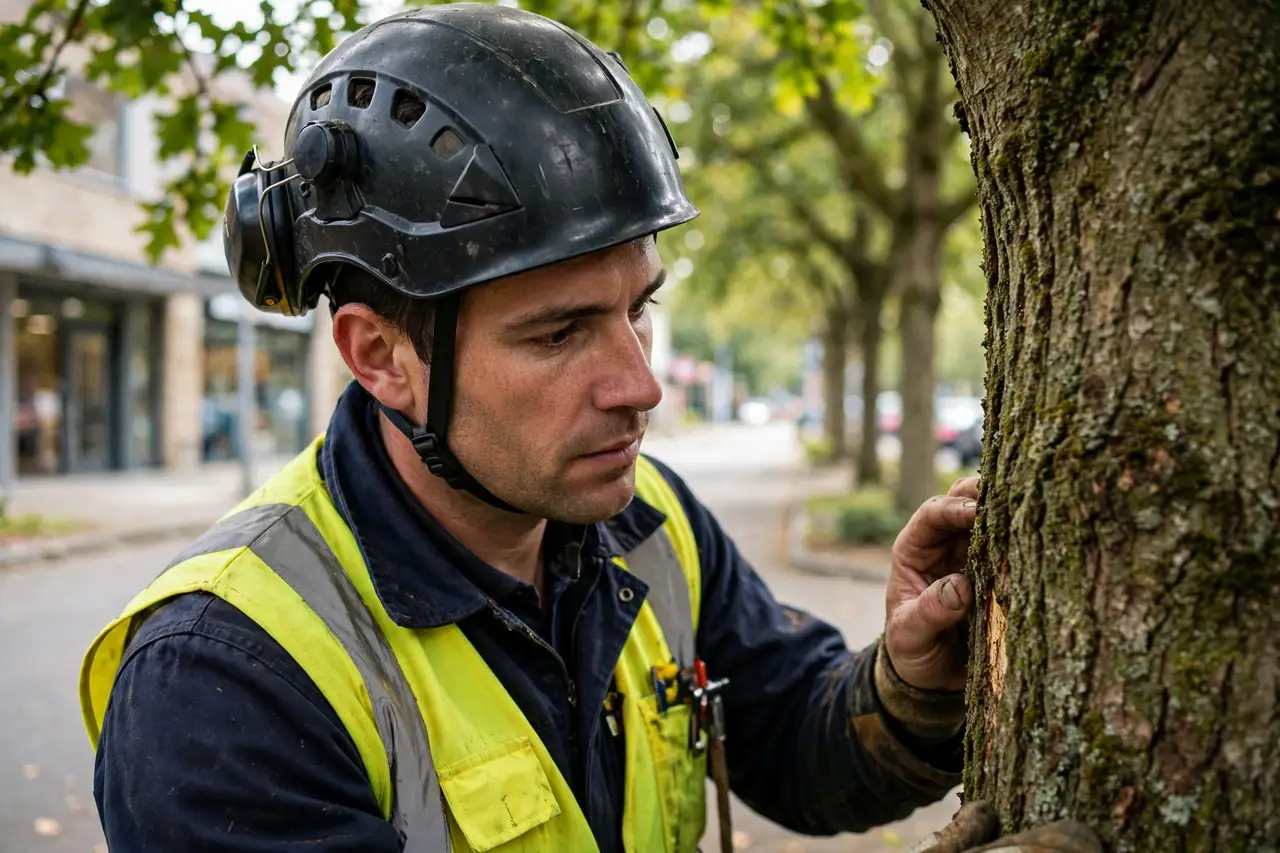
Programmes begin with a structured inventory: every significant tree located, sized, condition-rated and risk-flagged — the dataset everything else runs on.
Prioritised plan
Findings are ranked by risk and value into a phased programme: urgent safety work first, then health and structure, then aesthetics — spread across budget cycles.
Scheduled execution
Work is batched by site and season: dormant-season structure work, pre-storm-season clearance, growing-season health treatments — planned around your occupancy, not the crew's convenience.
Documentation per visit
Every visit closes with records: work done, photographs, updated condition notes — the compliance file your insurer and board will ask for.
Emergency cover
Programme clients get a defined storm-response route, so the 2 a.m. call reaches a provider who already knows the site and its trees.
Annual review
The inventory is refreshed, the next year's phases are set, and the programme adapts as trees, budgets and buildings change.
In detail
The liability mathematics of commercial trees
A property owner's tree duty is not to prevent every failure — it is to show that trees were inspected and managed reasonably. When a limb lands on a car, the first question asked is not 'why did the tree fail?' but 'when was it last assessed, and what did you do about it?' A documented programme is the answer; a shrug is a settlement.
This is why commercial work is built around records as much as saws. Risk-rated inventories, dated photographs and completion reports are not bureaucracy — they are the product, alongside the pruning itself. Providers who resist documentation are telling you something about how they run the rest of their work.
Planned beats emergency: the budget argument
Emergency tree work commands premium rates, arrives on the storm's schedule, and fixes one tree. A planned programme spreads the same total work across seasons at standard rates, fixes the causes (structure, deadwood, declining specimens) before they become events, and converts tree spend from a series of shocks into a budgetable line.
There is a second saving: trees managed on a cycle live longer and look better, deferring the removal-and-replacement cycle that neglected canopies arrive at all at once. Facilities managers who inherit a deferred property know the pattern — every tree emergency at the same time, in the same budget year.
Working around an occupied property
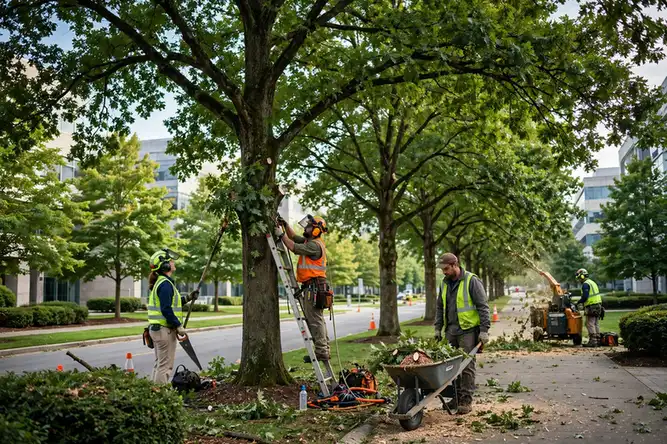
Commercial crews work to the property's rhythm: car parks sectioned before opening hours, school work in holidays, hospital entrances kept sacrosanct, tenants notified in advance. Noise windows, access routes, crane positions and debris logistics are planned like a small construction project, because that is what they are.
When comparing providers, ask how they phase work on an occupied site and who your single point of contact is. The cheapest crew that closes your main entrance on your busiest morning is not the cheapest crew.
Specifying commercial work: contracts that protect you
Commercial tree contracts earn their length. The clauses that matter: work specified to recognised pruning standards (so 'trim' cannot mean 'top'), insurance certificates verified and current, named supervision, photographic completion records, and a defined emergency call-out arrangement. Price belongs in the contract; so does everything that makes the price meaningful.
Multi-year programmes should carry a review mechanism — tree condition changes, buildings change, budgets change — and the inventory refresh is its natural vehicle. A provider who welcomes annual scrutiny of their own plan is telling you how they expect it to go.
Trees as an asset class: the property argument
Mature, healthy canopy is one of the few property features that appreciates by standing still: it shades parking and roofs (measurable energy savings), cools and quiets outdoor space, screens the unlovely, and signals to tenants, customers and students that the institution manages its estate. Developers plant token trees at completion precisely because buyers read canopy as quality.
The management conclusion follows: tree programmes belong in the asset plan, not the incident log. Budgeted, inventoried, pruned on cycle, your trees are infrastructure returning value; neglected until they fall, they are a liability with leaves. The difference is entirely the system this page describes.
Seasonal programmes: the commercial calendar
Commercial tree years have a rhythm. Winter carries the structural programme — pruning and planned removals while sites are quiet and trees are dormant. Spring is assessment season: the inventory refresh, storm-season preparation, and health treatments timed to pest and disease cycles. Summer is monitoring and response. Autumn closes the loop with next year's plan and the budget submission it feeds.
Written into a programme, that rhythm means no season arrives as a surprise and no budget is ambushed. It also means the provider's best crews, booked in the calm months, rather than whoever is available in the crisis — a difference tenants can see from the car park.
Communication: the hidden commercial service
Ask property managers what separates their best contractors and the answer is rarely the saws: it is the communication. Notice of works before the crew arrives, a named contact who answers, photographs of completion without being chased, and invoices that reference the plan line they fulfil. On an occupied site, silence from a contractor reads as disorder even when the work is flawless.
Specify communication in the programme documents the way you specify pruning standards: reporting format, photo requirements, notice periods, escalation route. Providers who already work this way will recognise the language; those who do not have just told you how the contract would feel.
Budgeting tree care as a line item, not a surprise
Properties that handle trees well share one habit: the work sits in the operating budget as a planned line, sized from the inventory — so much per tree per year for the cycle pruning, a contingency for storm response, a capital allowance for removals and replacements. Properties that handle trees badly fund them from emergencies, which is the most expensive possible way: rush rates, collateral damage, and the occasional liability settlement dwarfing a decade of planned care.
Building the first budget is a by-product of the inventory survey: tree count, condition distribution, cycle length and unit rates produce a defensible number a finance committee can approve, usually phased — hazard backlog in year one, cycle establishment across years two and three, steady state after. Managers who present tree care this way, with the risk register attached, rarely lose the argument; managers who present a single large pruning quote usually do.
Contractor management across a portfolio
For multi-site portfolios, the craft is consistency: one specification, one reporting format, one inspection standard across every property, so condition data can be compared and budgets allocated by need rather than by which manager shouts loudest. A single framework agreement with a firm or a small panel — rates fixed, response times contracted, insurance verified centrally — replaces dozens of local arrangements of varying quality.
Review the panel annually against the data: completion rates, report quality, incident record, price movement. Tree work is a relationship business at the crew level and a data business at the portfolio level; the managers who get the best of both keep the crews they trust, audit the paperwork like an accountant, and walk one property per quarter with the contractor to keep the standard honest.
What drives the scope of commercial work
- Tree count and size distribution. The inventory sets everything: fifty mature oaks is a programme; five young ornamentals is a visit.
- Risk profile of targets. Trees over buildings, parking and public ways demand more inspection frequency and documentation.
- Programme vs. project. One-off clearance vs. multi-year management are structured and priced differently.
- Access and scheduling constraints. Out-of-hours work, phased closures and crane logistics add planning scope.
- Reporting requirements. Board-level reporting, insurer documentation and permit handling are part of the deliverable.
- Geographic spread. Single-site vs. regional portfolio coverage changes the provider profile you need.
Should you do it yourself?
Commercial tree management has no DIY tier, for a simple reason: the liability is the organisation's, and 'our caretaker had a look' is not a management system. What in-house teams can usefully do is surveillance — reporting hangers, new leans, fungi and storm damage between scheduled visits, and keeping the area under a suspect tree closed until the provider attends. Eyes are cheap; put them in the system.
Frequently asked questions
How is commercial tree work different from residential?
Scale, stakes and paperwork. Commercial sites have public targets under trees all day, multiple decision-makers, insurance and audit requirements, and tree counts that need inventories and phased plans rather than one-off visits. The arboriculture is the same; the management system around it is the commercial product.
What documentation should we receive?
At minimum: a tree inventory with condition and risk ratings, dated photographs, work specifications before each phase, and completion records after it. Over time this file becomes your evidence of reasonable management — exactly what insurers and investigators ask for after any incident. If a provider cannot describe their reporting, they are not a commercial provider yet.
Can work be done outside our operating hours?
Yes — commercial programmes routinely schedule around occupancy: early mornings, weekends, school holidays, phased car-park closures. Constraints are agreed in the plan and reflected in the programme's structure. The earlier constraints are on the table, the better the plan fits them.
Do you handle permits and protected trees for us?
Commercial providers routinely manage the permit process — identifying protected trees, preparing applications and arborist reports, and scheduling work within permit conditions — as part of the programme, since a portfolio will meet ordinances regularly. Ultimate responsibility stays with the property owner, which is another reason the documentation matters.
What does a tree inventory involve?
A site visit (or series) recording each significant tree's location, species, size, condition, defects, risk rating and recommended actions with priorities. The inventory becomes the working dataset for budgeting and scheduling, and is refreshed on the programme's review cycle. It is the single most valuable first step for any property with more than a handful of trees.
How do emergency calls work under a programme?
Programme clients get a defined route: a known number, a provider who already holds the site inventory, and pre-agreed authority to make safe first. Storm response under those conditions is faster and cheaper than cold-calling during a regional event, when every crew's queue is long and triage favours their existing clients.
Can one programme cover multiple sites?
Yes — portfolio programmes are the norm for management companies, school districts, retail and hospitality groups. The inventory standardises data across sites, work is batched geographically for efficiency, and reporting consolidates for the board while staying specific per site. Providers are matched by coverage; ArborReach routes by the site's location, so multi-state portfolios are handled region by region under one plan.
Who is liable if a tree fails between inspections?
Liability turns on what was reasonable: a documented inspection cycle, action on the findings, and records to prove both are the core of the owner's position. No programme makes a property owner immune — trees are living structures in weather — but the difference between a managed failure and a neglected one is the difference insurers and courts actually examine. This is general information, not legal advice; your insurer and attorney set your specific duties.
How do we start if our trees have never been managed?
With the inventory — it is designed exactly for cold starts. Expect the first visit to produce more questions than answers: species, sizes, conditions and risks recorded tree by tree, with the urgent handful flagged for immediate action. From that dataset the first-year plan usually writes itself: safety items in season one, structure and health phased behind them. Properties that begin this way consistently report that year two feels unrecognisable compared with the crisis rhythm they started from.
Can a programme help with our sustainability reporting?
Yes, and increasingly this is a stated reason for commissioning one. A documented canopy — inventoried, health-tracked, planted and pruned on plan — is reportable environmental performance: canopy cover figures, replacement ratios, habitat provisions like retained deadwood in safe positions, and waste streams chipped to mulch rather than landfilled. If your organisation reports on ESG lines, ask for the inventory data in a format your reporting can consume; a mature provider will treat that as a normal deliverable, because by now it is one.
What size of property justifies a programme?
The threshold is not acreage but exposure: a small site with mature trees over a busy entrance can need a programme more than a large quiet one. As a practical guide, if your property has more trees than you can count from memory, or any tree whose failure would reach people, vehicles or buildings, a structured inventory and plan will pay for itself in avoided surprises.
Commercial Tree Service in top metro areas
Related services
Need commercial tree service? Talk to a local professional
One call connects you with an independent tree service in your area — for an assessment, a quote, or urgent help with a dangerous tree.
Call NowArborReach USA is a referral service. We connect property owners with independent local tree care professionals; we do not perform tree work ourselves.