Tree care in Seattle
Every metro has a personality written in its trees, and Seattle's is shaped by evergreen-heavy yards where conifers tower over roofs and root zones are often compacted by construction. The Seattle–Tacoma–Bellevue area's canopy — built largely from Douglas fir, western red cedar, bigleaf maple and red alder — does the everyday work of cooling streets, holding soil and framing neighbourhoods, and it carries the region's characteristic weaknesses too.
The practical consequence is that tree care in Seattle is not generic. Pruning runs on the local calendar (Late winter is the workhorse pruning window here, before spring growth and after the worst of the wind season; structural work on young maples and firs pays off for decades.) Storm preparation is a standing appointment rather than a reaction, because the area's defining weather — winter windstorms rolling in off the Pacific — tests every weak union and dead limb it finds. And the health threats are specific enough to name, which this page does below.
ArborReach's role in Seattle is the connection: one call routes you to an independent local tree professional who works these streets and species daily. The sections below are the local brief that professional would give you — the numbers, the risks, the calendar — so you can have the assessment conversation as an informed owner.
The local picture: housing, canopy and climate
Those figures explain most of what a Seattle arborist sees. Housing built around 1985 — 60% of it owner-occupied — means the metro's trees were largely planted as landscape features by builders and first owners, grew up with the suburbs, and are now, together, at the age where structure, deadwood and root conflicts become the work. Climate loads the dice further: roughly 54°F average temperatures with the rain arriving in the pattern the Pacific Northwest knows well — long dry spells, then storms that test everything at once.
Seattle's tree risks, named
Saturated winter soils plus tall evergreen canopies are the classic Northwest failure pattern: roots lose their grip just as the strongest winds of the year arrive, and whole trees can uproot rather than snap.
The health threats an assessor checks first in this area:
- Laminated root rot. A slow root disease of douglas fir and other conifers that hollows the root system years before the crown thins — a common reason mature firs topple in winter storms.
- Swiss needle cast. A fungal needle disease of douglas fir that yellows and thins the canopy along the coast ranges.
- Aphid and adelgid pressure. Sap-feeding insects that coat maples and hemlocks in sticky honeydew and stress trees already coping with summer drought.
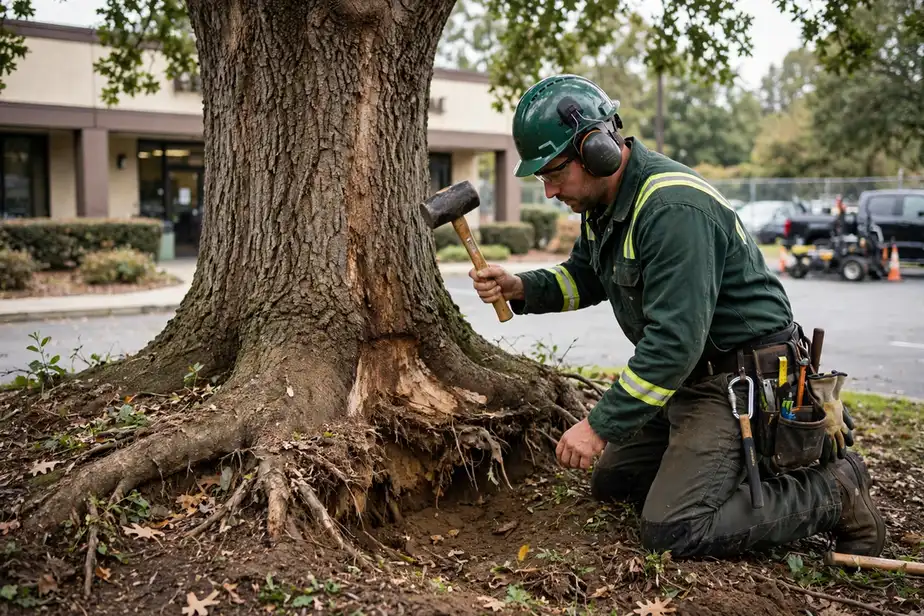
Tree services in Seattle
When a Seattle tree becomes an emergency
Given winter windstorms rolling in off the Pacific, every Seattle owner should know the sequence: keep clear, call the utility if lines are involved, photograph from a safe spot, then call for emergency service. The crews ArborReach connects you with unload storm trees the safe way — rigged, sectioned, and documented for insurance.
The Seattle tree care calendar
The structural season in Seattle: with the canopy bare (or thinned by the cold), arborists read unions and defects clearly and do the heavy pruning and planned removals. Average winter conditions here bring about 30 days at or below freezing across the year — dormant wood and firm ground make this the efficient working window.
Growth flushes and the first storms test winter's work. In the Seattle–Tacoma–Bellevue area, spring is for health checks — watching which trees leaf out weakly — and for finishing structural work before winter windstorms rolling in off the Pacific season gathers strength.
With roughly 4 days above 90°F in a typical year, Seattle trees earn their shade. Summer work means deadwood and hazards only, deep watering for young trees in dry spells, and watching for the local disease signatures listed above.
The planning season: assessments for the winter programme, planting while soil is still warm, and a hard look at any tree the summer stressed. Owners who book winter work in autumn get the schedule they want; owners who wait for the first storm join its queue.
Pruning window, in short: Late winter is the workhorse pruning window here, before spring growth and after the worst of the wind season; structural work on young maples and firs pays off for decades.
The standard of tree work to expect in Seattle
There is a standard of tree work worth insisting on in Seattle, and it is visible within ten minutes of a crew arriving. The lead climber walks the tree first — in King that means reading the Douglas fir and bigleaf maple that dominate the older canopy, checking the unions and the flare, and only then rigging the job. With 44% of the area's housing built before 1980, a large share of Seattle trees are at the age where yesterday's small defects become tomorrow's failures, and inspection is what catches them in the cheap years.
The rest of the standard is housekeeping and honesty: brush chipped or hauled as agreed, no topping dressed up as pruning, and a straight answer about timing — work that suits the local calendar rather than the sales calendar. Seattle's winter windstorms rolling in off the Pacific history argues for crews who plan around it instead of profiting from it. When you compare providers, compare those habits; the difference between tree companies is rarely the saws, and almost always the judgement.
Communities and counties served
ArborReach's Seattle coverage spans the metro's communities, including:
SeattleTacomaBellevueKentEverettRentonFederal WayKirklandAuburnRedmondMarysvilleSouth HillSammamishLakewood
Representative ZIP codes served include 98001, 98011, 98025, 98036, 98050, 98070, 98103, 98117, 98136, 98174 and the wider Seattle–Tacoma–Bellevue area.
Counties in the Seattle–Tacoma–Bellevue metro
Nearby metro areas
Seattle tree service FAQs
How much does tree removal cost in Seattle?
There is no honest flat figure — removal scope in Seattle turns on the tree's height, its position over your home, and access for equipment, as it does everywhere. What we can tell you is what your local arborist will weigh: 1,681,971 housing units across the Seattle–Tacoma–Bellevue metro means plenty of tight suburban lots where trees come down in rigged sections rather than felled whole. Read our cost-factors guide, then get the number that matters — the one quoted standing at your tree. The local evidence behind that answer: across King, Pierce, Snohomish, in communities from Seattle to Tacoma and Bellevue, under ZIP codes such as 98001, 98011, 98025, the canopy of Douglas fir, western red cedar and bigleaf maple is the one this question is really about.
When is the best time to prune trees in Seattle?
Late winter is the workhorse pruning window here, before spring growth and after the worst of the wind season — that is the regional rhythm here. In the Seattle–Tacoma–Bellevue area the climate sharpens the choice: with about 35 inches of rain a year and 4 days above 90°F on average, local trees work hard in summer and rest in winter. Your ArborReach Seattle page's calendar section breaks the year down season by season. The numbers underneath it, for the Seattle–Tacoma–Bellevue metro: 1,681,971 housing units, a median build year of 1985 with 44% of homes pre-dating 1980, about 35 inches of rain a year, 4 days above 90°F and 30 freezing days — and the standing health threats of laminated root rot, swiss needle cast and aphid and adelgid pressure.
Which trees cause the most problems in Seattle, WA?
The metro's canopy leans on Douglas fir, western red cedar and bigleaf maple, and the trouble list follows from them. The most serious local health threat is laminated root rot — a slow root disease of Douglas fir and other conifers that hollows the root system years before the crown thins — a common reason mature firs topple in winter storms. Add storm behaviour — winter windstorms rolling in off the Pacific — and most Seattle call-outs trace back to those few causes. Set against the metro itself: 4,161,883 people, 1,586,350 households, neighbours in Bremerton and Olympia, and older districts around Seattle where the Douglas fir canopy predates most of the housing beneath it.
A tree fell in a storm in Seattle. What should I do first?
Keep people and pets clear of the tree and anything it is resting on, and if it touches a power line, call the utility before anyone else. Photograph the damage from a safe distance for insurance. Then call for emergency tree service: in the Seattle–Tacoma–Bellevue area, storm work is triaged — trees on houses and blocked access first. Our storm-damage guide walks through the first 48 hours in order. The local evidence behind that answer: across King, Pierce, Snohomish, in communities from Seattle to Tacoma and Bellevue, under ZIP codes such as 98001, 98011, 98025, the canopy of Douglas fir, western red cedar and bigleaf maple is the one this question is really about.
Can a leaning tree in my Seattle yard be saved?
Sometimes. A long-standing lean in a tree with a sound root plate can be stable for decades, while a new lean — especially with soil lifting on the far side after one of the area's winter windstorms rolling in off the Pacific — signals roots letting go, and that tree is a removal candidate. The difference can only be judged in person: an arborist will read the root flare, the soil and the crown before recommending cabling, reduction or removal. The numbers underneath it, for the Seattle–Tacoma–Bellevue metro: 1,681,971 housing units, a median build year of 1985 with 44% of homes pre-dating 1980, about 35 inches of rain a year, 4 days above 90°F and 30 freezing days — and the standing health threats of laminated root rot, swiss needle cast and aphid and adelgid pressure.
Who handles stump grinding in Seattle?
The same local professionals ArborReach connects you with — grinding is often bundled with a removal or booked on its own for an inherited stump. Across communities like Seattle, Tacoma, Bellevue, Kent, stumps sit in the same soils and the same turf, and a standard grind finishes below lawn level so you can seed or plant over it. Tell the provider if you plan to replant the spot; depth and backfill change with the plan. Set against the metro itself: 4,161,883 people, 1,586,350 households, neighbours in Bremerton and Olympia, and older districts around Seattle where the Douglas fir canopy predates most of the housing beneath it.
How old is the tree canopy in Seattle, and why does it matter?
Much of it grew up with the housing: the median home in the Seattle–Tacoma–Bellevue metro was built in 1985, and 44% of homes predate 1980 — which means a large share of the metro's shade trees were planted in the same decades and are reaching mature, high-maintenance age together. Mature canopies need structured care: deadwood cycles, union checks and health monitoring, before storms make the decisions. The local evidence behind that answer: across King, Pierce, Snohomish, in communities from Seattle to Tacoma and Bellevue, under ZIP codes such as 98001, 98011, 98025, the canopy of Douglas fir, western red cedar and bigleaf maple is the one this question is really about.
Can I get help choosing a replacement tree for my Seattle property?
Yes — the planting services we connect you with start from your site: soil, sun, space at maturity and what you want the tree to do. Locally, Douglas fir and red alder are proven performers in the Pacific Northwest conditions. The key rules are universal: right species for the space, root flare at grade when it goes in, and deep watering for the first two seasons. The numbers underneath it, for the Seattle–Tacoma–Bellevue metro: 1,681,971 housing units, a median build year of 1985 with 44% of homes pre-dating 1980, about 35 inches of rain a year, 4 days above 90°F and 30 freezing days — and the standing health threats of laminated root rot, swiss needle cast and aphid and adelgid pressure.
Does ArborReach serve my part of the Seattle–Tacoma–Bellevue metro?
Our coverage follows the metro's counties — King, Pierce and Snohomish — and the communities within them, including Seattle, Tacoma, Bellevue, Kent and many more listed on this page. If you are on the metro's edge, call anyway: routing is by nearest serving professional, not by a hard boundary on a map. Set against the metro itself: 4,161,883 people, 1,586,350 households, neighbours in Bremerton and Olympia, and older districts around Seattle where the Douglas fir canopy predates most of the housing beneath it.
What should I check before hiring a tree service in Seattle?
Three things, in this order: an insurance certificate you can hold in your hand, a refusal to top your tree (ask — it separates professionals from pretenders instantly), and a written scope that states the stump and debris finish. Our hiring guide gives the full checklist. Every provider ArborReach connects you with is an independent local business, so do the same checks you would with any contractor — a good one will welcome them. The local evidence behind that answer: across King, Pierce, Snohomish, in communities from Seattle to Tacoma and Bellevue, under ZIP codes such as 98001, 98011, 98025, the canopy of Douglas fir, western red cedar and bigleaf maple is the one this question is really about.
Tree service in Seattle — one call away
One call connects you with an independent tree service in your area — for an assessment, a quote, or urgent help with a dangerous tree.
Call NowArborReach USA is a referral service. We connect property owners with independent local tree care professionals; we do not perform tree work ourselves.